

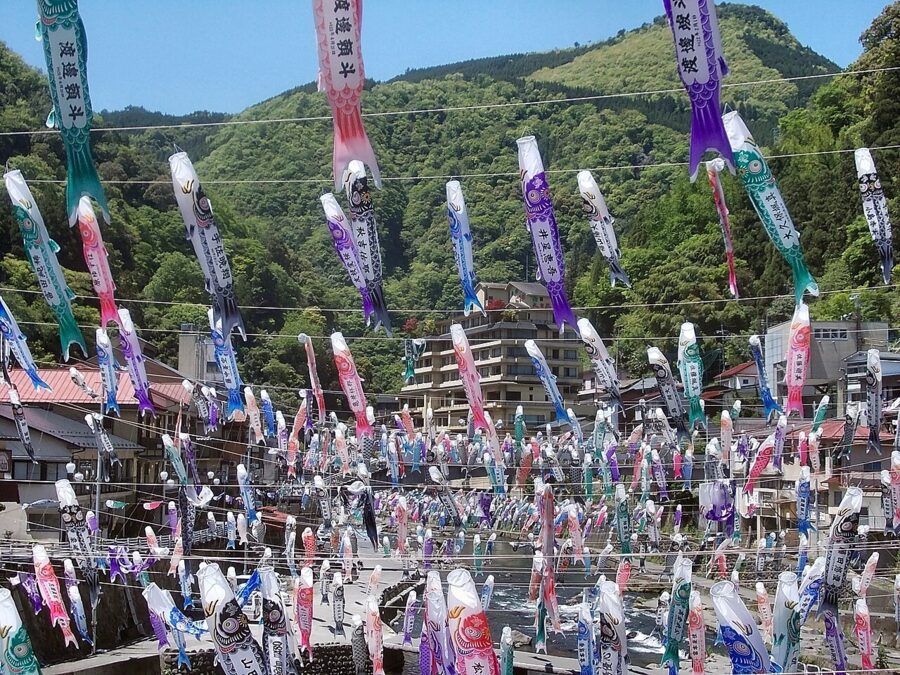
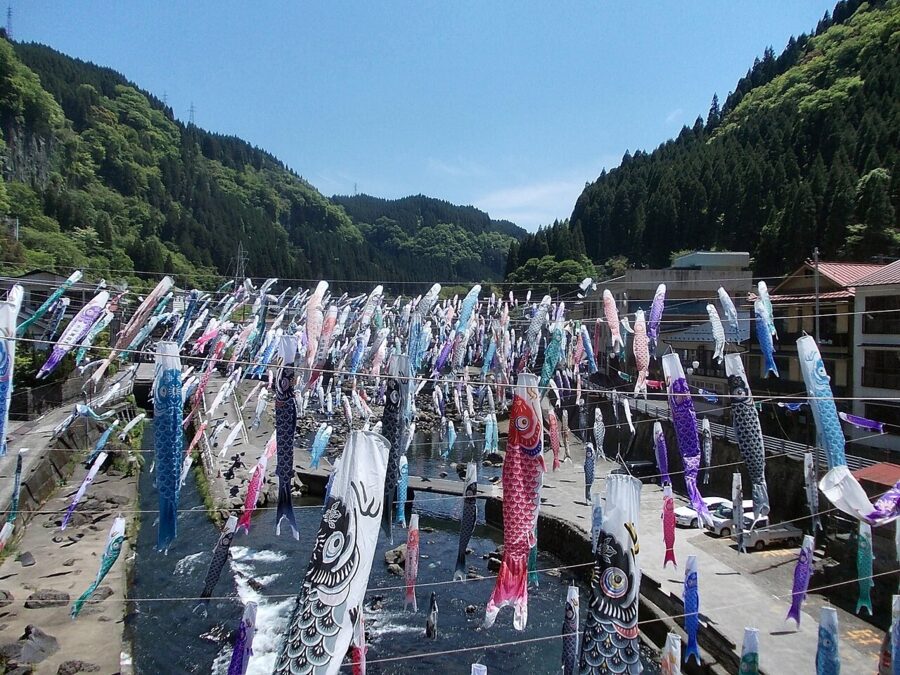
At Tsuetate (杖立) the steam comes up from both banks of the river at once. The hot spring town is packed into a gorge so narrow that the inns stack up the slopes for want of flat ground, and the water arrives at about 98°C, hot enough that on a cold morning you see the town breathing before you see the buildings. Every spring it strings thousands of koinobori (鯉のぼり), carp-shaped streamers, on ropes across the river.
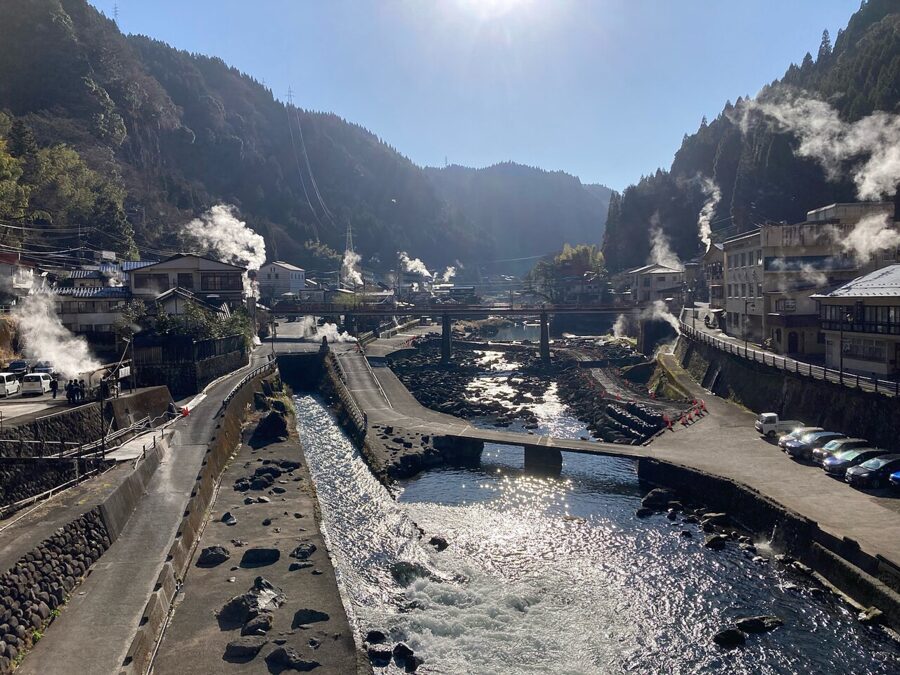

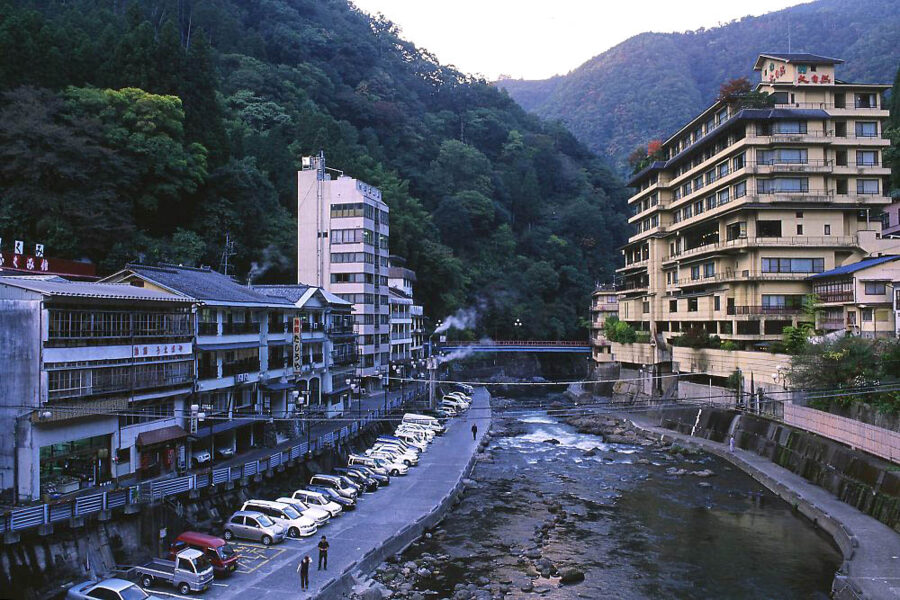
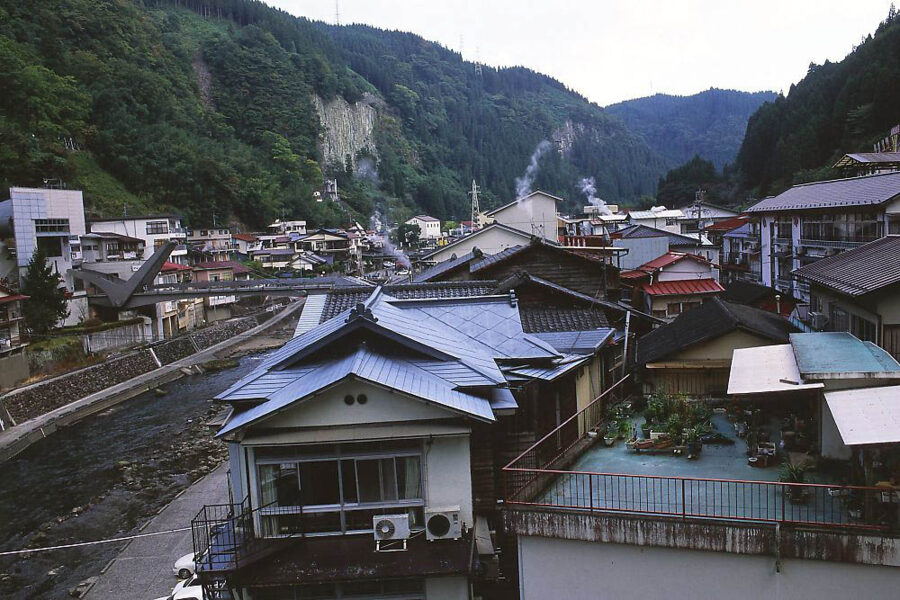
It sits at the northern tip of Oguni, on the border with Ōita Prefecture, and it is not tidy. Boom-era concrete hotels lean over old wooden inns, and behind them runs a maze of stairs and alleys the town calls sedoya. The baths are cheap and the public steamers free, so a day is enough, though a night lets you see the gorge go quiet.
One thing first. Heavy rain in July 2026 damaged the left-bank riverside road that doubles as festival parking, and the tourism association expects the repairs to run to about the end of February 2027. The inns, shops and restaurants are open as usual, but the 2027 carp festival will only be dated once the road is fixed.

Contents13 parts
- A town with no flat ground
- Legends, lords and the Showa boom
- The carp streamer festival
- Cooking with steam
- Steam baths, the local cure
- The public baths and the footbath
- Day bathing at the inns
- Walking the sedoya
- Tsuetate after dark
- Where to eat and shop
- Getting there
- Waita, Kurokawa and the rest of Oguni
- When to go
A town with no flat ground
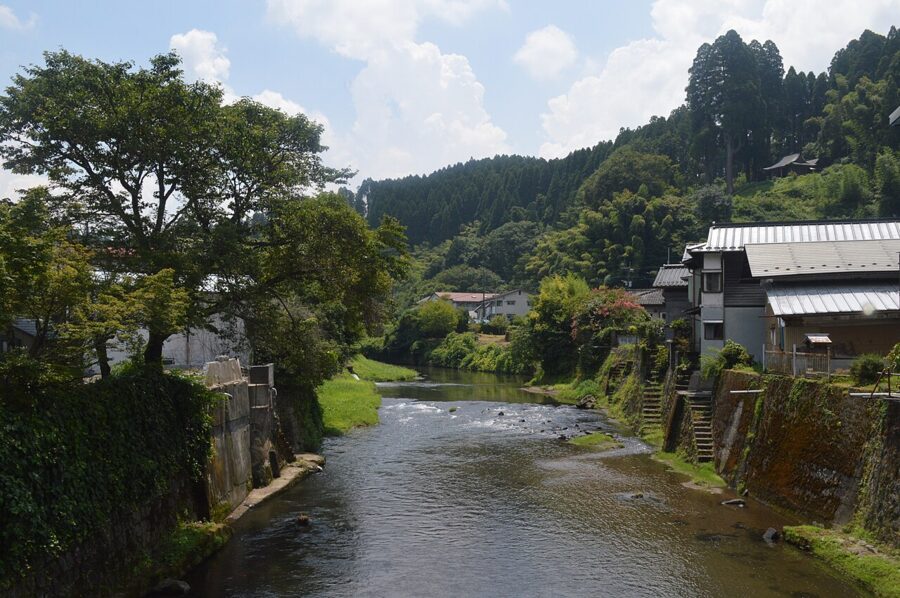
The Tsuetate River runs north out of Oguni toward Hita and the Chikugo River, and at Tsuetate it cuts a deep, wooded gorge through old lava. The town fills both sides of it, with three bridges tying the banks together. Part of it spills over into Hita in Ōita Prefecture, and the hills around it belong to the Yaba-Hita-Hikosan Quasi-National Park.
The water is the reason for all of it. The tourism association counts 26 sources in town, and the spring comes out at 98 to 100°C, much of it flowing up on its own. It is clear, close to neutral, slightly salty and rich in metasilicic acid, the mineral Japanese spa guides credit for the soft feel on your skin. Every bath has to cool it first, and the spare heat becomes the steam that defines the place.

Eighteen inns belong to the association, from family places with eight rooms to Hizenya (ひぜんや), which has 143 and traces its founding to 1690. Hizenya stands on the prefectural line, marked inside the building, and its Kumamoto wing bathes in Tsuetate water while its Ōita wing uses water from Amagase, a spa town in Hita.

Legends, lords and the Showa boom
The staff that took root
The name means “staff standing,” and it comes with two legends. In one, the monk Kūkai (Kōbō Daishi) passed through early in the Heian period, pushed his bamboo staff into the ground, and watched it sprout leaves. In the other, the sick arrived leaning on walking sticks and went home without them.
A geographer, Matsuo Toshirō, offered a drier reading: the place name Tsue, found just over the border in Hita, may be an old word for a cliff. Standing in the gorge, that is easy to believe.
The empress’s spring
The town also claims about 1,800 years of bathing, which rests on an older legend. The pregnant Empress Jingū went into labor at Munakata in northern Kyushu, and a white-haired old man told her attendants to follow the river southeast to a sacred spring for the baby’s first bath; the child became Emperor Ōjin. The little rock bath called Motoyu, at the foot of Momiji Bridge, is said to mark that spring, though today it is fed from another source.
From the lord’s bath to “the inner parlor of Kyushu”
In the Edo period the lords of the Kumamoto domain kept a private bath here, the origin of today’s Gozen-yu (御前湯). From the Meiji era writers came to stay, among them the poet Noguchi Ujō, and the novelist Hino Ashihei wrote a book set here while lodging at the inn Hagakure-kan. In 1953 the great flood of western Japan tore through the valley, and the town rebuilt.
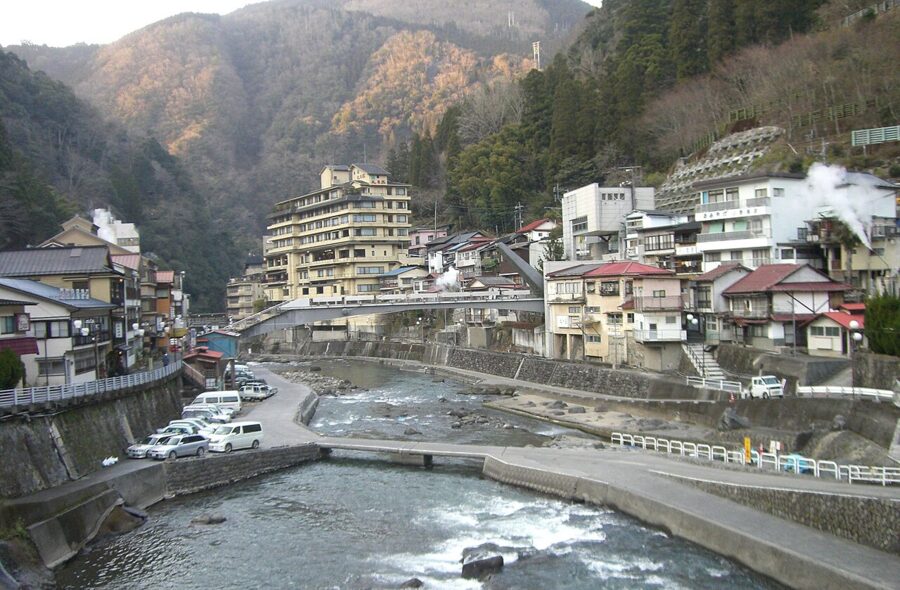

Then came the high point. In the early and middle Showa period Tsuetate was “the inner parlor of Kyushu,” a pleasure town with shooting galleries, pachinko and pinball before its neighbors had them, and the inns kept adding floors. By the Heisei years tastes had changed and the crowds thinned, just as nearby Kurokawa was rising. The July 2020 floods hit the town hard again, and every inn was back open by March 2021.
The carp streamer festival
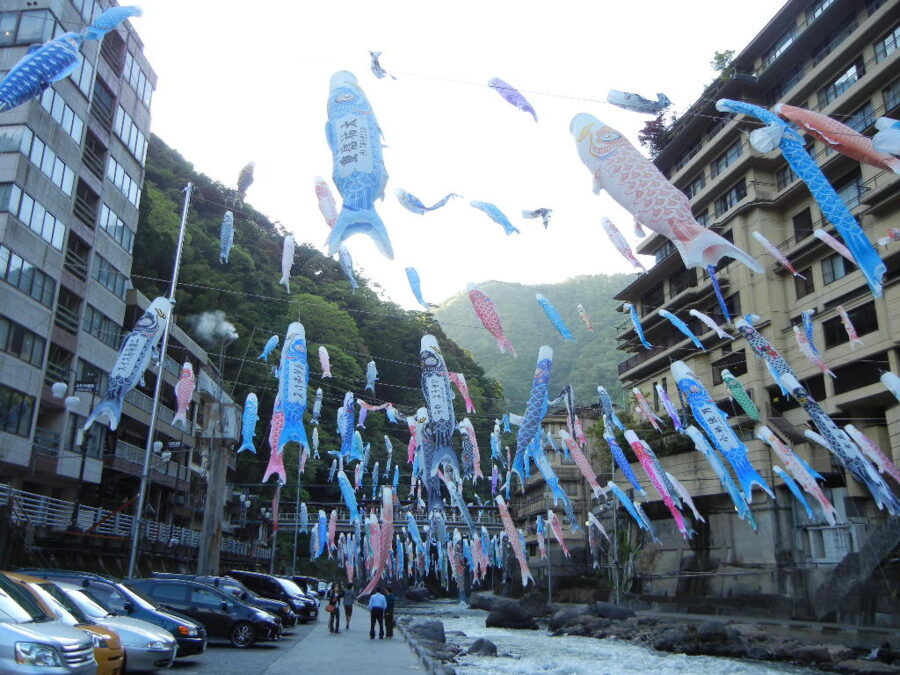
Tsuetate calls itself the birthplace of the river-crossing carp festival now copied all over Japan. Families in the gorge had nowhere to raise the tall poles koinobori normally fly from, so around 1980 they began throwing a ball on a rope from bank to bank and hanging the streamers between. The first year there were about 40; donations from across the country have kept the count at some 3,000 to 3,500 for years.
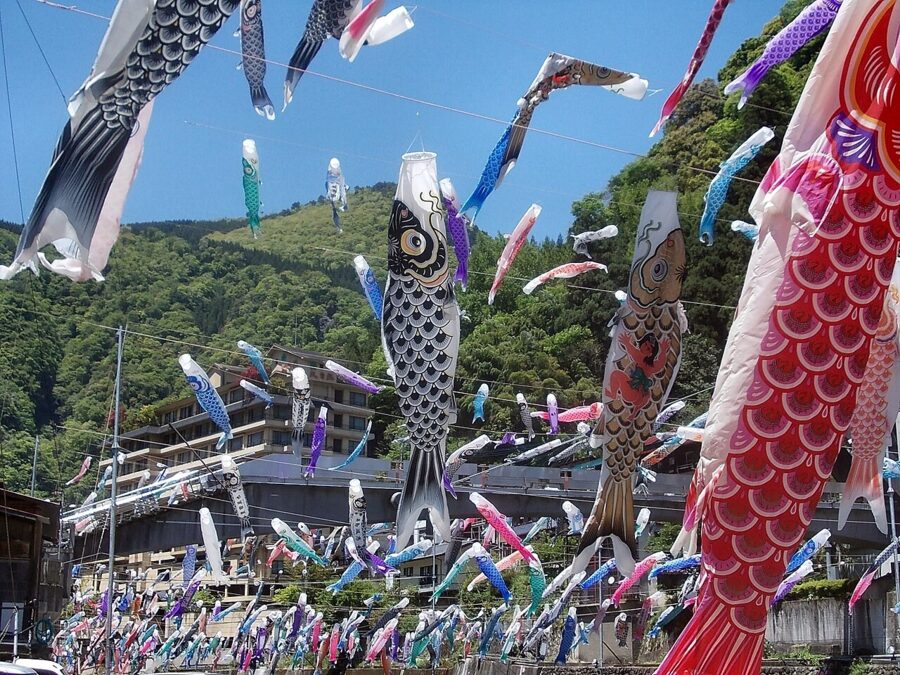

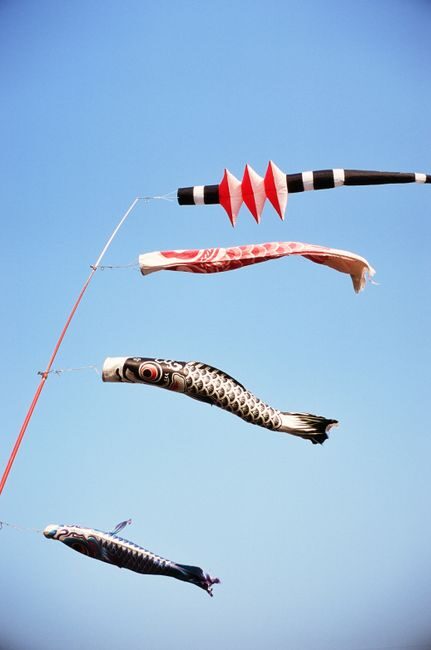
Koinobori fly for Children’s Day on May 5, a wish for children to grow up strong, the way a carp swims upstream. The town plays on the word too, since koi also means love, which is why the wooden carp plaques under the roof of Momiji Bridge are bought mostly for romantic wishes.
When it runs, as of 2026
For decades the festival ran from April 1 to May 6. That has changed. In 2026 it ran from Saturday, March 28 to Thursday, April 23, finishing before Golden Week on purpose, because the one road through the gorge could not take the holiday traffic. The streamers are lit after dark, and entry is free.
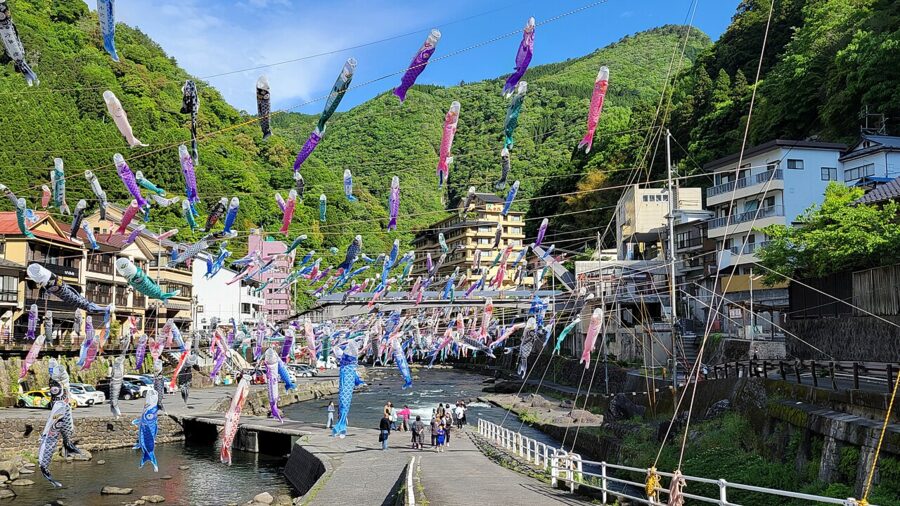

For 2027 nothing is fixed. The town describes the festival as running from late March to late April, outside Golden Week, but in September 2026 it tied the date to the road repairs. Check the association’s notices in February before you book.
Seeing it without the crowds
Festival weekends fill the riverside lots and back traffic up the road. I would come on a weekday, early, when the steam is still thick over the water. Izumiya, one of the riverside inns, recommends Tsuetate Bridge for the view straight down the river, and the riverside walk for getting right under the lines.
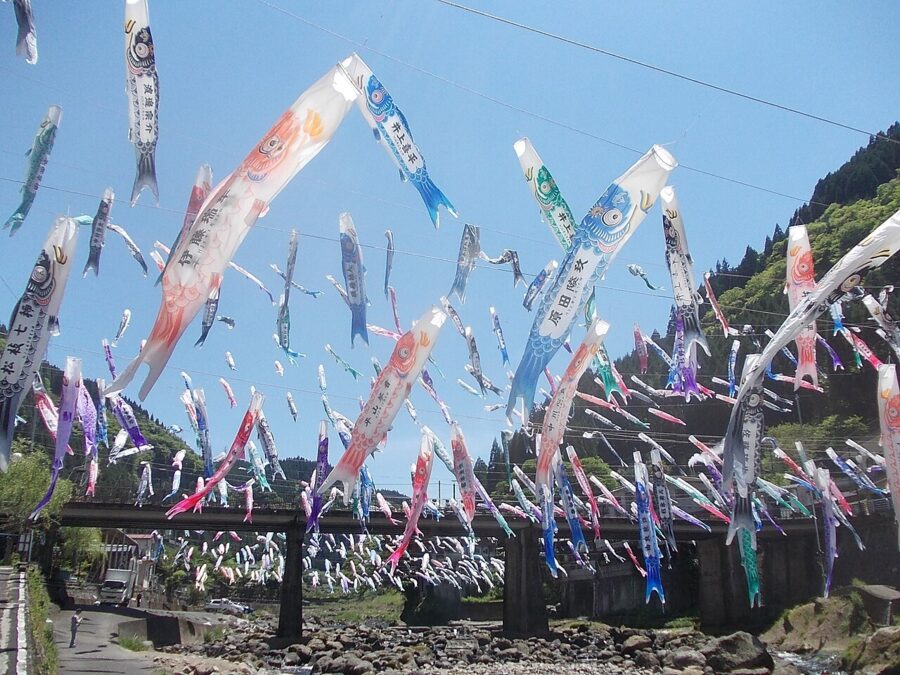

Each of the three bridges has a small Jizō statue: for love on Tsuetate Bridge, health on Momiji Bridge, and raising children on Sakura Bridge, whose head gets rubbed a lot in carp season.

Cooking with steam
Dotted around the streets are mushi-ba (蒸し場), public steam stations where spring heat is piped into covered cookers. They are free and open to anyone: bring eggs, sweet potatoes or vegetables, put them in one of the bamboo steamer baskets left there, lower them over the vent and wait.
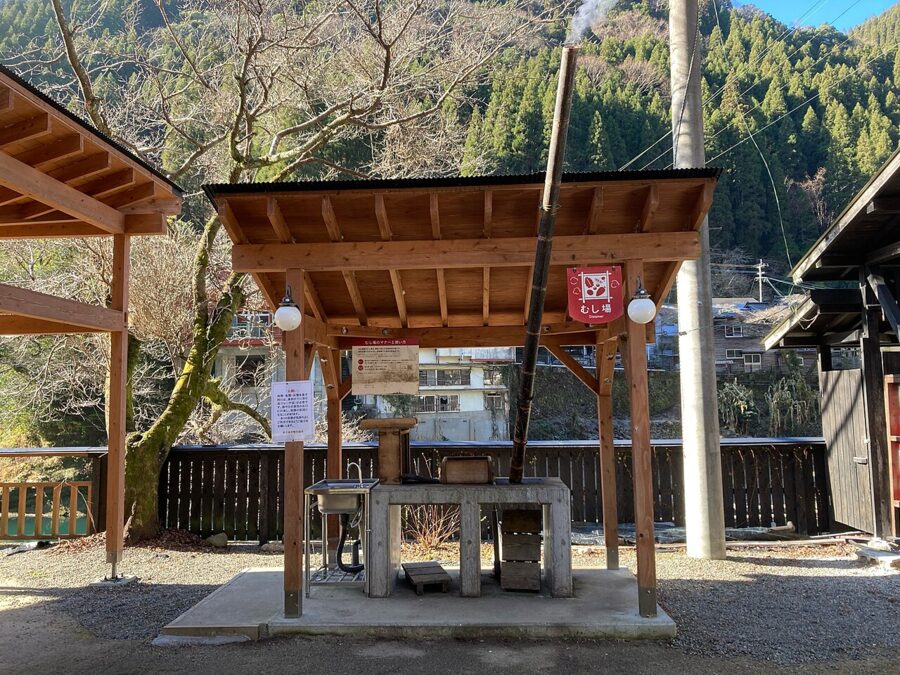

The tourism association sells eggs and sweet potatoes for exactly this, and Kumamoto’s tourism board suggests the order: food in, footbath, then eat. Bring salt and something to carry hot eggs in. During the 2026 festival the inn Izumiya also sold its own steamed eggs, chatama, for ¥100 (about US$1) each.
The old guest dish was amatamago (甘玉子), sweetened egg custard steamed over the springs, much like a set pudding. The inns revived it as the Tsuetate pudding, and each one makes its own version with Oguni’s Jersey milk, so a pudding after the bath is a small local habit worth keeping.
Steam baths, the local cure
Most inns here have a mushi-buro (むし風呂), a steam bath fed by the spring. The traditional kind is a low, cave-like room behind a small door where you lie on the floor in the vapor; newer ones seat you in a wooden box with your head outside. Locals say “if you catch a cold, the steam bath first,” and June 4 is registered as Tsuetate Onsen steam-bath day.
The association’s advice is simple. Wash in the spring first, drink a glass of water, take in a bucket of water and a towel, and stay five to ten minutes, lying spread out like the character 大. If the room feels fierce, splash water on the floor first, and rinse off in the spring afterward.
The public baths and the footbath
Tsuetate still keeps its kyōdō-yu (共同湯), the small neighborhood baths residents use every day. They are plain, with no soap or towels, and you pay by dropping coins in a box at the door. The association lists the prices below as of November 2026.
- Motoyu (元湯): a half-open rock bath at the foot of Momiji Bridge, the spot tied to the empress legend. Free, mixed, and right beside the riverside path, so bathing in it takes some nerve. No toilet, and bring your own towel.
- Yakushi-yu (薬師湯): under the Yakushi hall, a tiled tub with pale blue walls. The spring pours in hot and you add tap water to taste. ¥200 (about US$1).
- Gozen-yu (御前湯): across the river, the bath linked to the Kumamoto lords. A pink-tiled tub that holds three, lit by a skylight. ¥200.
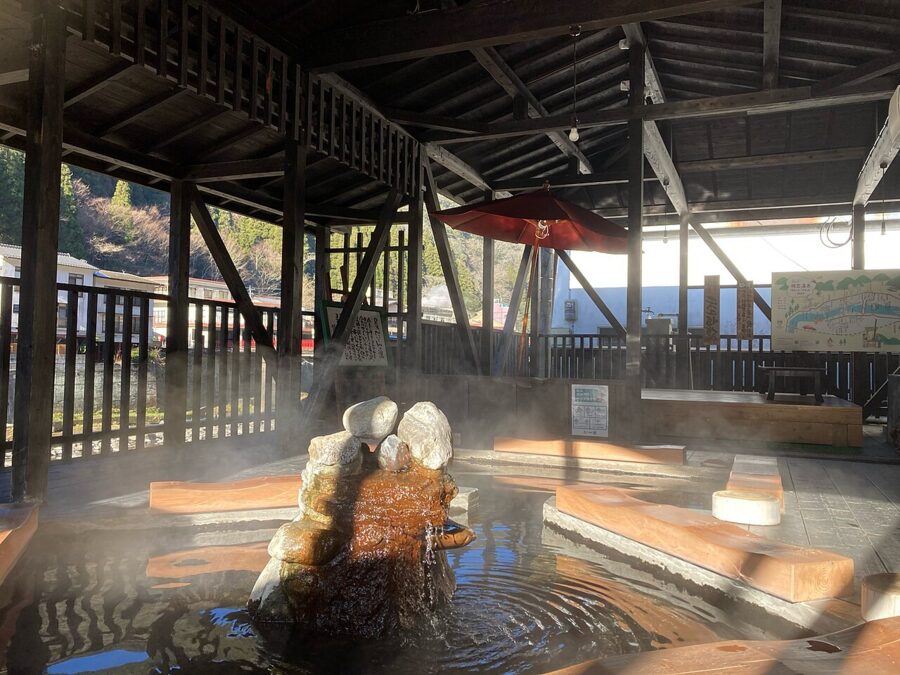

The footbath, Oyu no Eki (御湯の駅), is the easiest bath in town and costs nothing. It sits beside the free tourist parking lot near the tourism association office, and it is the place to wait while your eggs steam.
Day bathing at the inns
Several inns open their baths to day visitors, and this is how most people bathe here. The prices and hours below are as listed by Oguni town’s tourism association and the inns’ own sites in November 2026. Closing days are irregular, so ring before you go out of your way.
| Bath | Hours | Adult / child |
|---|---|---|
| Hizenya, main baths | 3:00 to 10:00 p.m., sauna to 9:00 p.m. | ¥1,600 (about US$11) / ¥800 (about US$5) |
| Kisshō no Yu, Hizenya’s riverside park | Weekdays 3:00 to 10:00 p.m.; weekends and holidays 11:30 a.m. to 11:00 p.m. | ¥1,600 / ¥800; private family bath ¥3,500 (about US$23) an hour |
| Izumiya | Weekdays 9:00 a.m. to 8:00 p.m.; weekends and holidays 9:00 a.m. to 3:00 p.m. | ¥800 / ¥500 (about US$3) |
| Komeya Bessō | 10:00 a.m. to 4:00 p.m. | ¥600 (about US$4) / ¥400 (about US$3); family bath ¥2,000 (about US$13) |
| Hakusuisō | 2:00 to 6:00 p.m. | ¥500 / ¥300 (about US$2) |
Kisshō no Yu (吉祥の湯) is the big one: an open-air park of rock, lava, wooden and barrel baths on the river, a few minutes’ drive from the hotel, mixing three springs with no added water. Its six family cottages go to whoever reaches the counter first. Hizenya itself suits a long soak on a cold evening, with sleeping baths and a low-temperature sauna.
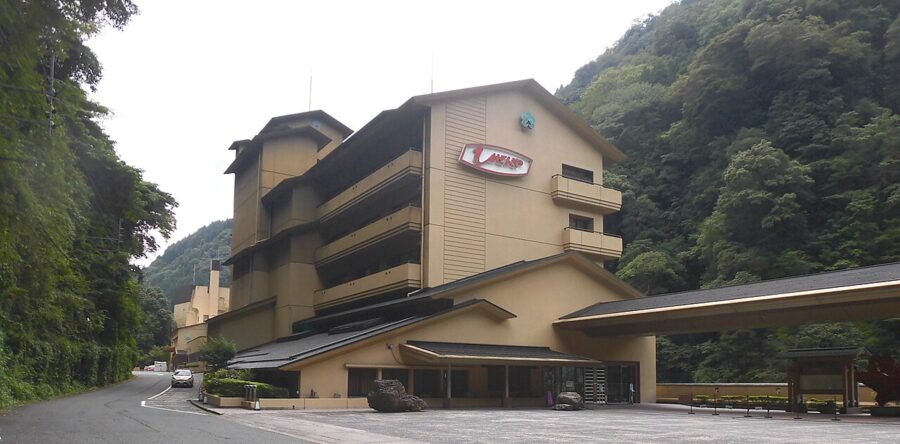

For something older, Izumiya (泉屋) is a four-story wooden inn about 150 years old, with a stone-garden bath, a tuff-lined bath long used by bathers on cures, and four kinds of steam bath. Komeya Bessō (米屋別荘) has a bathhouse of private open-air baths, and Hakusuisō (白水荘), in the sedoya near Momiji Bridge, is the cheapest of the inn baths, blended from its own two springs.
Walking the sedoya
Cross the river from the parking lot and go one street back, and the town changes. The sedoya (背戸屋) were the back ways behind houses, and in Tsuetate, where buildings were extended again and again in the Showa years, they became a maze of steps, kitchen doors, drainpipes and sudden views of the river.
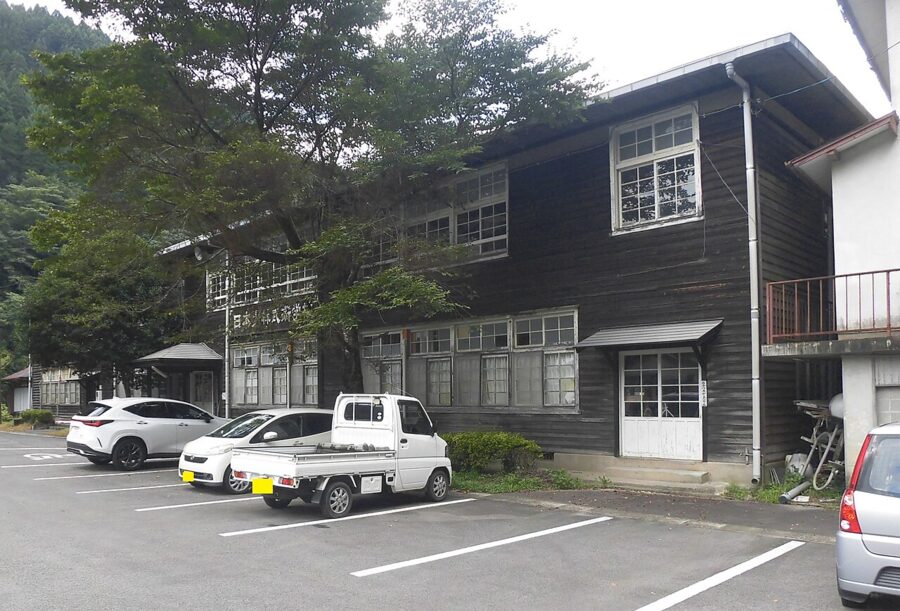

A local group, Team Sedoya, has hung old photographs of the town in handmade frames along the lanes, so the walk doubles as a gallery of the boom years. You cannot really get lost, because downhill always leads back to the river, but you can lose an hour easily.
Along the way, the Yakushi hall, the Tōrin Ruri-dō (東林琉璃堂), honors Kōbō Daishi, with Yakushi-yu underneath; next door, the Ikime Hachiman shrine is for eye trouble, and people leave old glasses there in thanks. A long flight of stone steps climbs to the Daijingū, the town’s guardian shrine.

End at Momiji Bridge, the roofed bridge at the downstream end. Under its roof hang hundreds of e-koi (絵鯉), carp-shaped cedar plaques that a bamboo workshop at the foot of the bridge first made in place of the usual wooden prayer boards. They stay up all year, long after the cloth carp are packed away.
Tsuetate after dark
Night is when the gorge looks most like itself. Lit windows color the steam from below, the river gets louder as the road goes quiet, and the old pleasure-town signs glow over empty streets. Walk the riverside path once after dinner.
Do not expect nightlife: as of September 2026 Hizenya opens its bowling alley and game corner from 5:00 to 10:00 p.m. on Fridays, Saturdays and Sundays only. In festival weeks the lit carp turn the river into a glowing ceiling, and that is when a night here pays off most.
Where to eat and shop
Most visitors eat at their inn, and the town’s few places to eat are modest. These were trading in summer 2026, when the inns’ union listed them as sellers of its Yuge no Mori bath salts:
- Shokudō Komatsu: a family diner of noodles, rice bowls and set meals, run by the same family for about half a century.
- Pukupuku: a small café and craft shop opened in a lane that had been all shutters, with frozen pudding and handmade goods.
- Hōsaku Ichiba: the roadside souvenir shop on the main road, with local vegetables, fruit and crafts.
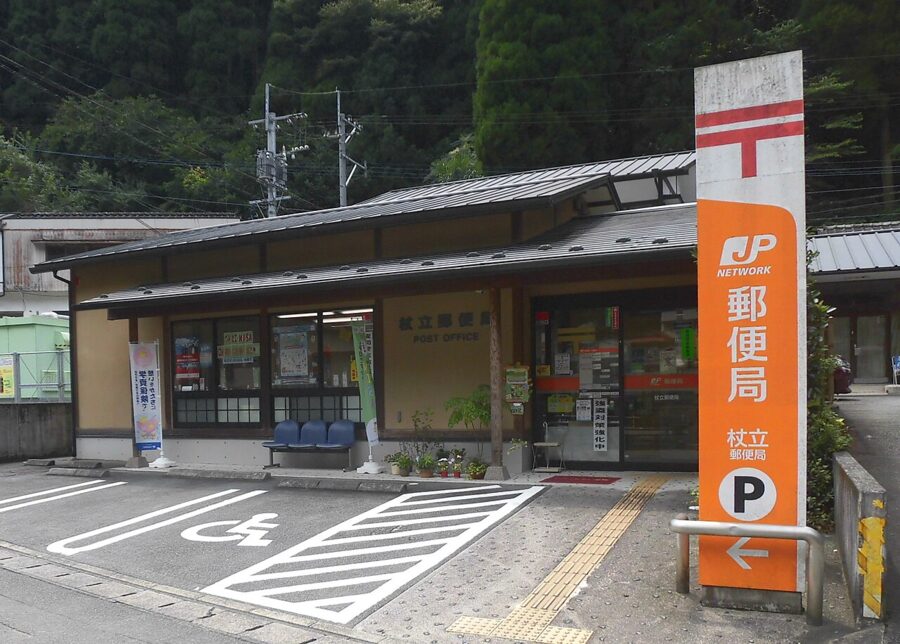
- R Shop Kajika: the area’s only convenience store, next to Hizenya’s annex Daishizen.
Several inns sell their Tsuetate pudding to day visitors as well, so ask at the one where you bathe. For a wider choice of restaurants, Oguni’s town center is a short drive south.

Getting there
By car
From Fukuoka, take the expressways to Hita IC, then Route 212 south for about 25 km (16 miles), about 90 minutes in all. From Kumamoto it is about 63 km (39 miles) by Route 57 to the old Aso town and Route 212 north, about 1 hour 40 minutes. The association’s access page covers other starting points.
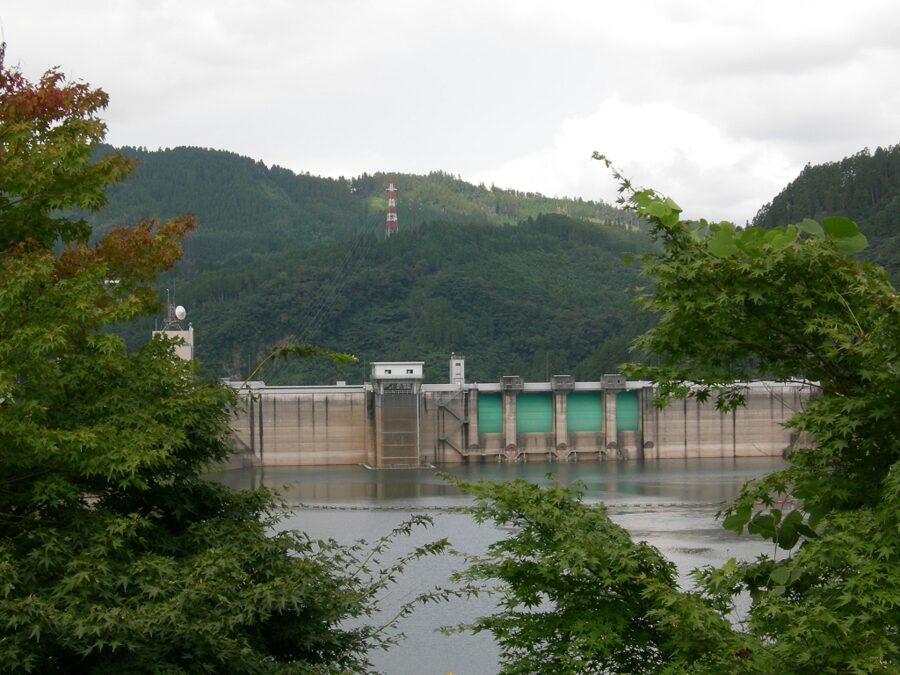
Route 212 dives into a tunnel at the edge of town; take the old road beside the tunnel mouth, which drops into the hot spring town. Park in the free communal lot near the tourism association office, though in past festival seasons parking has been charged. Until the flood repairs finish, the left-bank riverside road is closed for parking, so weekends are tight.
By bus
The Fukuoka to Kurokawa expressway bus, run by Kyushu Sanko and Hita Bus, stops at Tsuetate. It runs three round trips a day, two in the morning and one in the afternoon, seats must be reserved, and the adult fare from Tenjin to Tsuetate is ¥3,400 (about US$23) under the timetable in force since October 2025. Count on about two and a half hours from Tenjin.
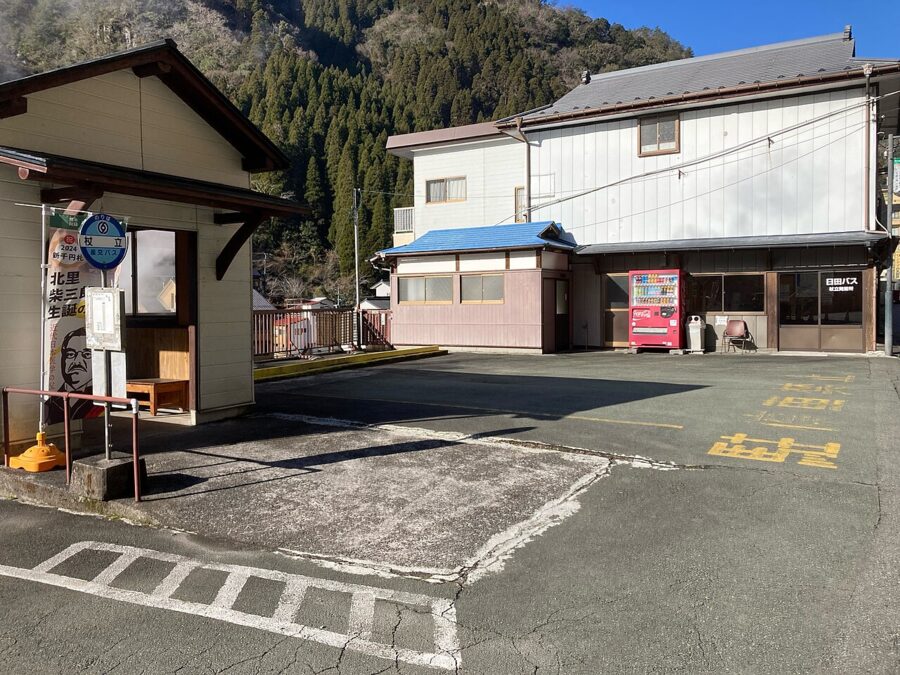

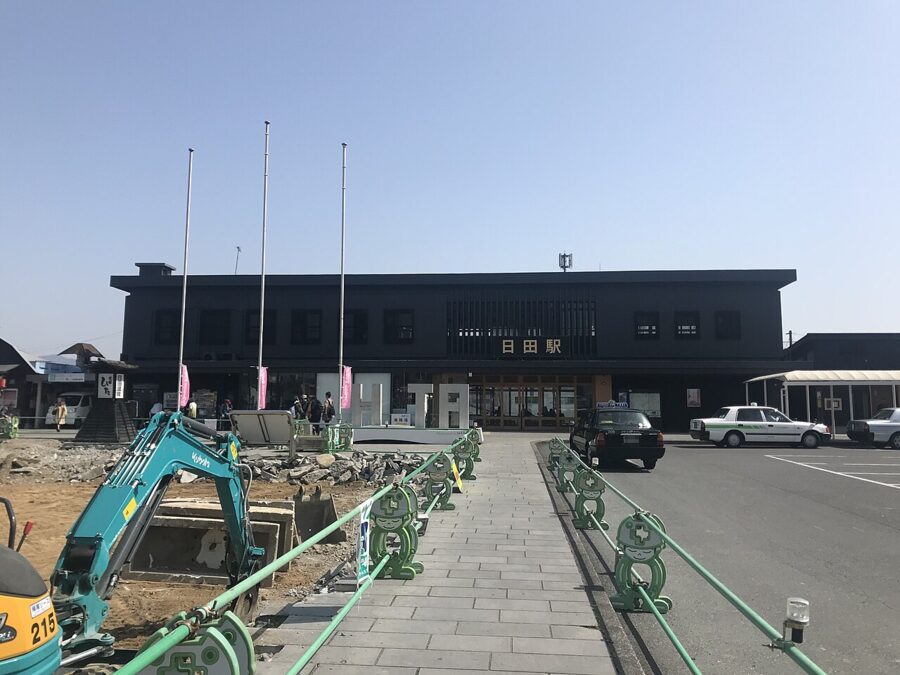
By local bus, Hita Bus runs from the terminal opposite JR Hita Station on the Kyūdai Line, the easier rail link from Fukuoka, and Kyushu Sanko runs from Aso Station on the Hōhi Line through Oguni’s Yū Station, the route from Kumamoto. Check the operators’ current timetables before you rely on them, and see getting to Oguni for the connections.

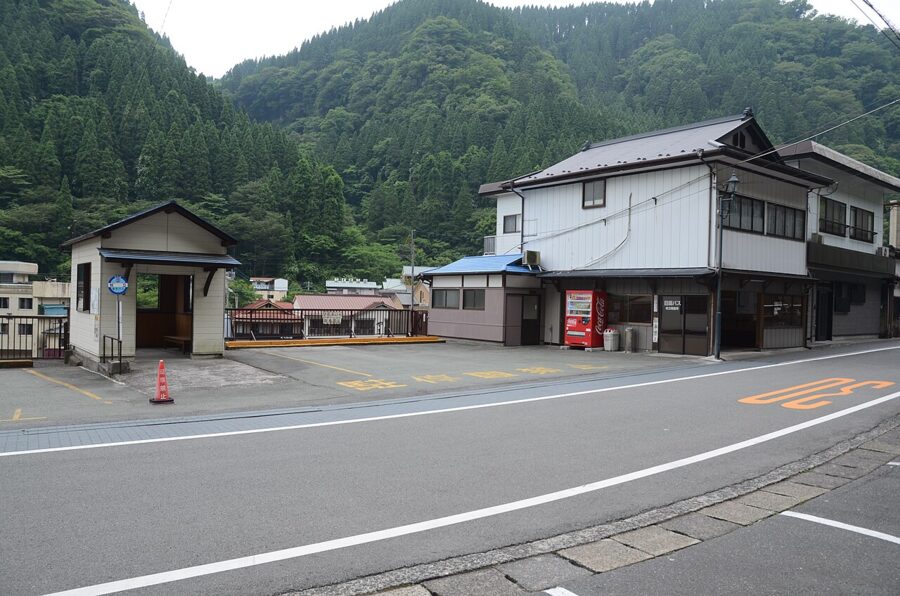
Waita, Kurokawa and the rest of Oguni
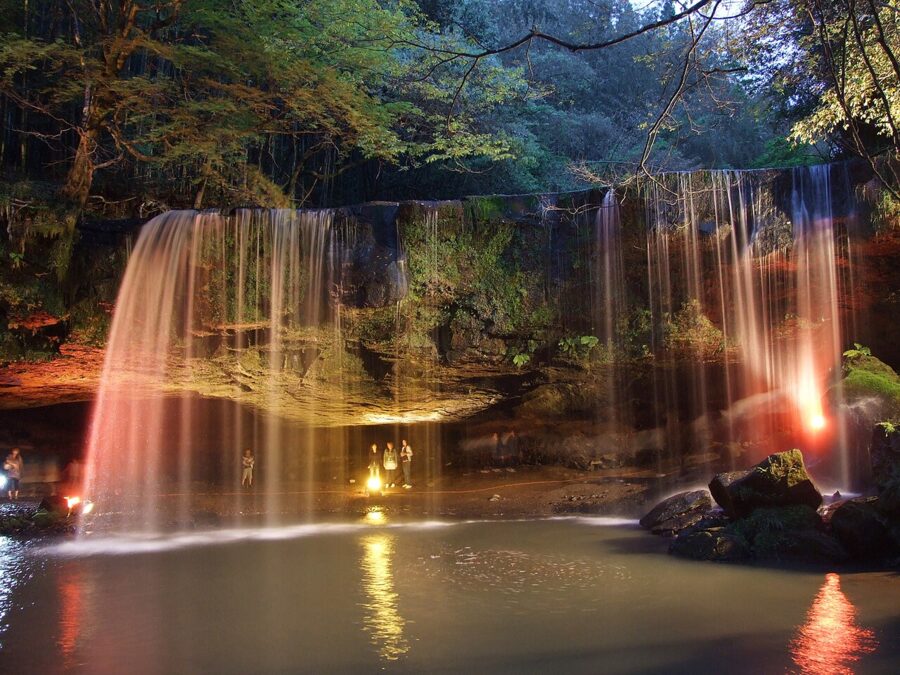
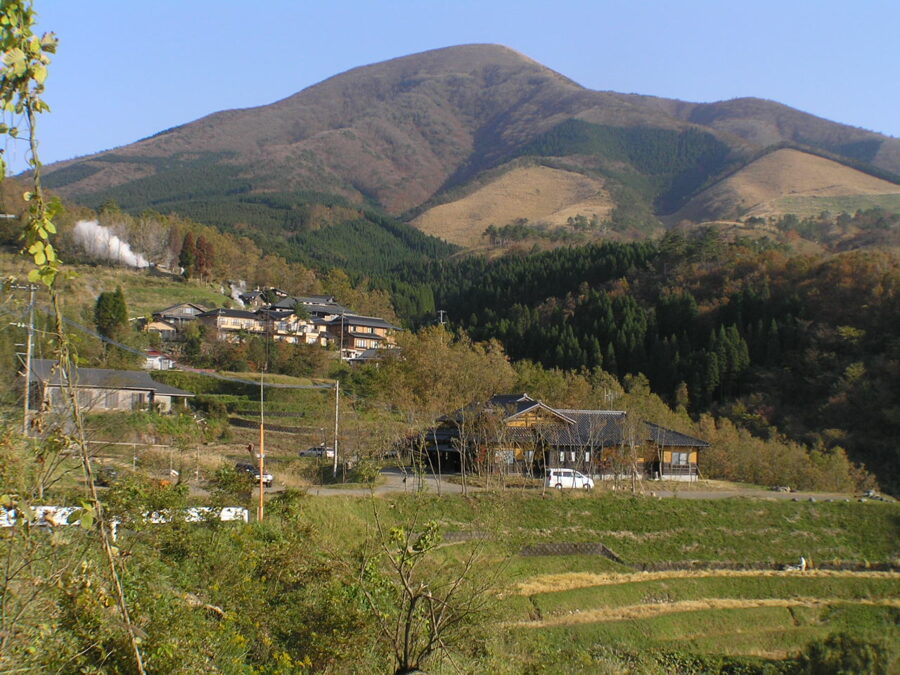
Most of what else you came for lies south along Route 212. The Shimonojō ginkgo stands beside the road toward the town center, and Nabegataki, the waterfall you walk behind, takes timed reservations made online in advance. West of the center, Waita is the other half of Oguni’s hot spring country, hamlets around steam vents where people cook in the ground.


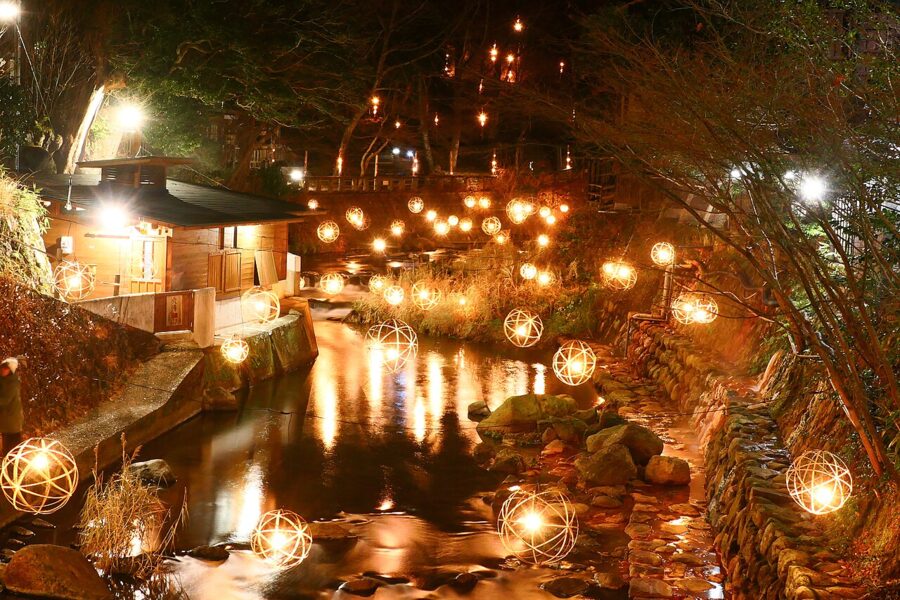
Kurokawa Onsen, in the separate town of Minamioguni, is about half an hour away, and the expressway bus links the two directly. They make a neat contrast: Kurokawa is wooded, low and carefully kept, while Tsuetate is steep, dense and frankly a little worn. I would sleep in one and bathe in the other.
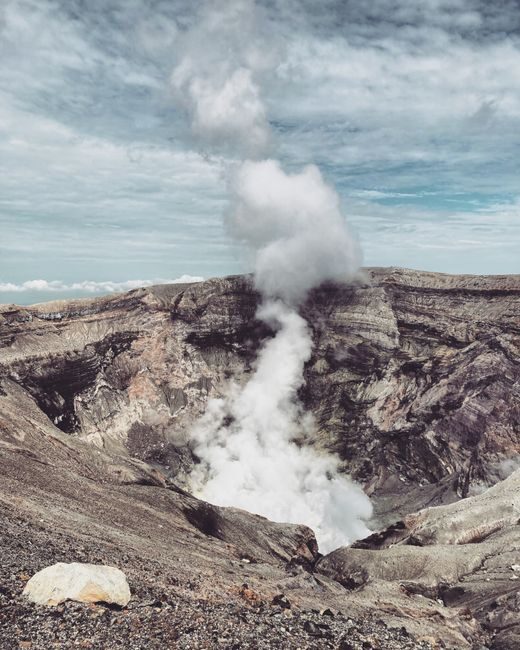
Mount Aso is a separate day trip, south past the old Aso town. As of the Japan Meteorological Agency’s bulletin of November 20, 2026, Aso was at volcanic alert level 2, with the area within about 1 km of the Nakadake first crater closed, so check before you set out.
When to go
Late March and April are the obvious choice, when the carp are up, and the move away from Golden Week has made the festival easier to enjoy. A weekday in the first half of the run is the sweet spot, with cool mornings that keep the steam thick under the streamers.
Winter is the season I would pick for the town itself. The near-boiling water makes clouds of steam in cold air and the baths feel best when the air is sharp. In autumn the wooded walls of the gorge change color, and in deep winter the roads over Oguni’s hills can ice up.
In the rainy season of June and July, watch the forecast: floods damaged the town in 1953, 2020 and July 2026. Tsuetate came through the earthquake of July 28, 2026 without serious damage, and Oguni’s roads and baths were open as normal by late August.

Whenever you come, start the same way: buy a few eggs, put them in a town steamer, and sit in the footbath while they cook. By the time they are done you will have watched the steam come off the river long enough to understand why people have been stopping here, staff in hand, for so long.