
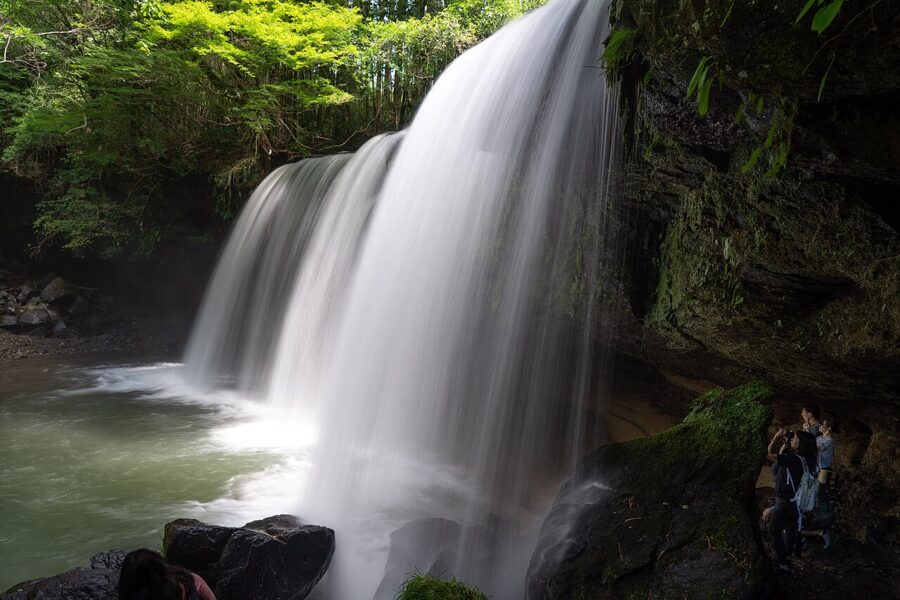

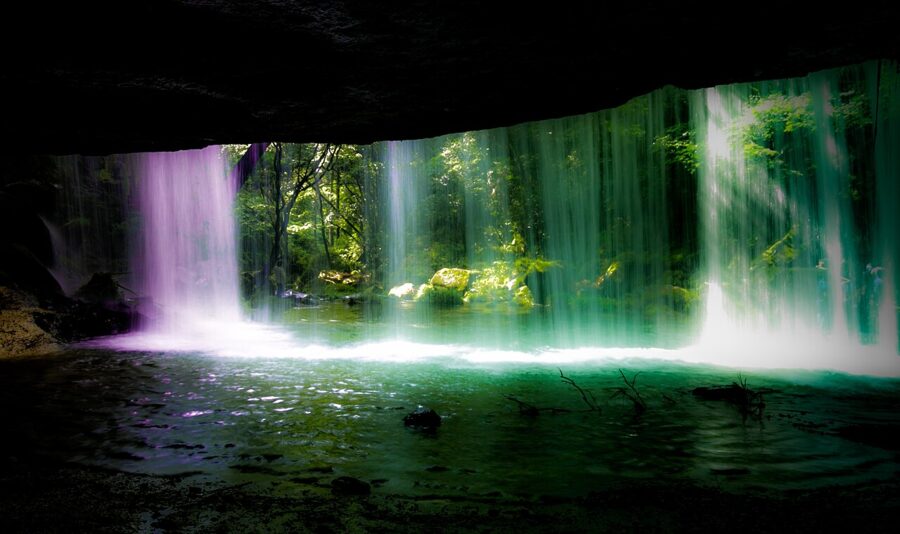
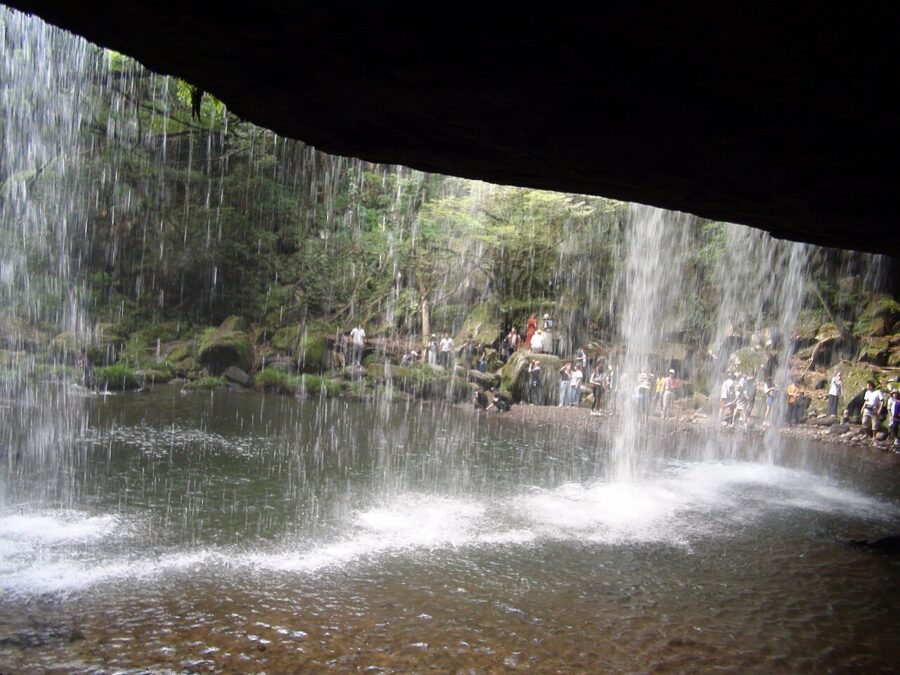
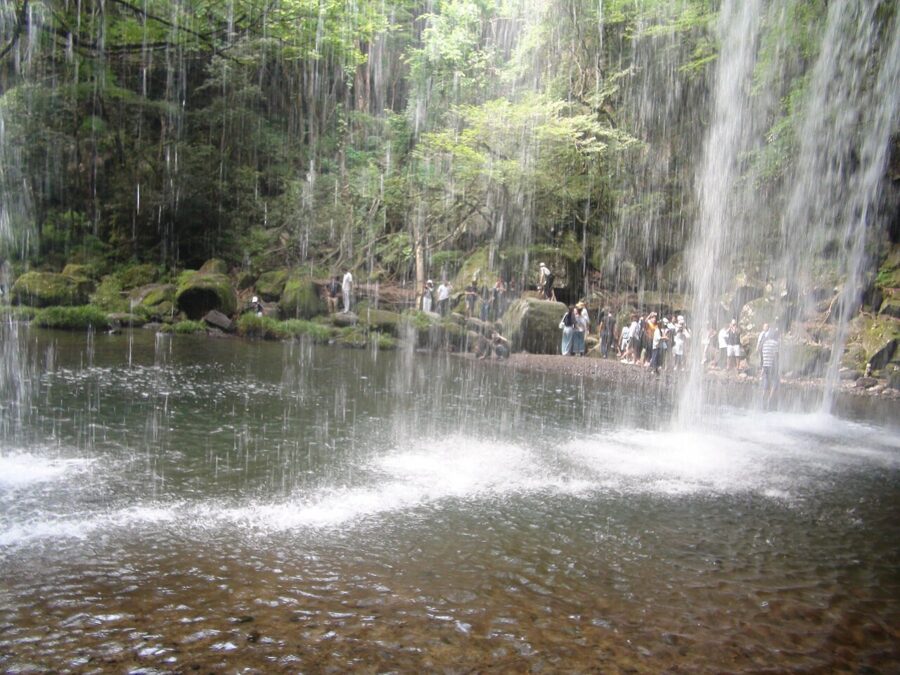
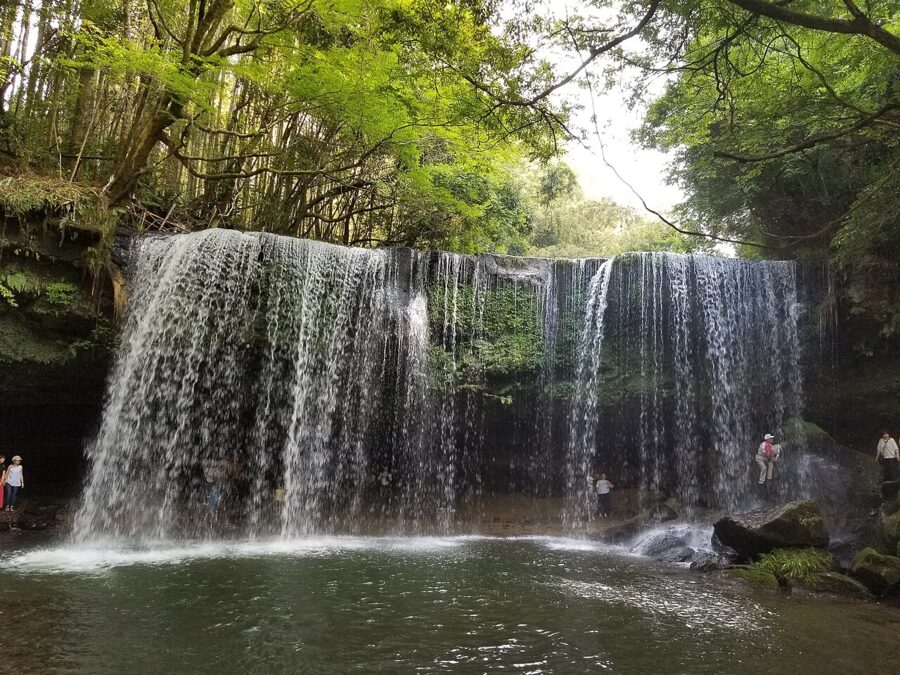
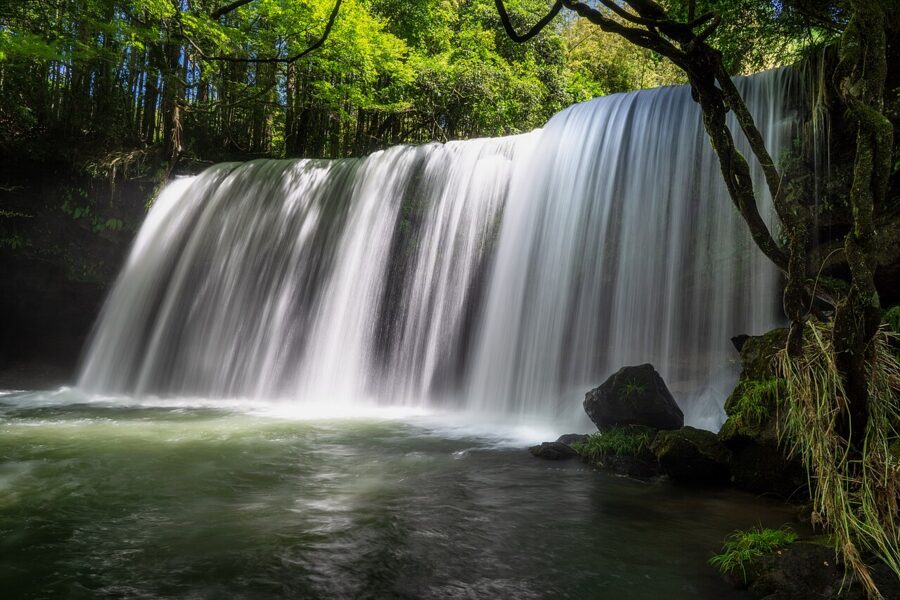
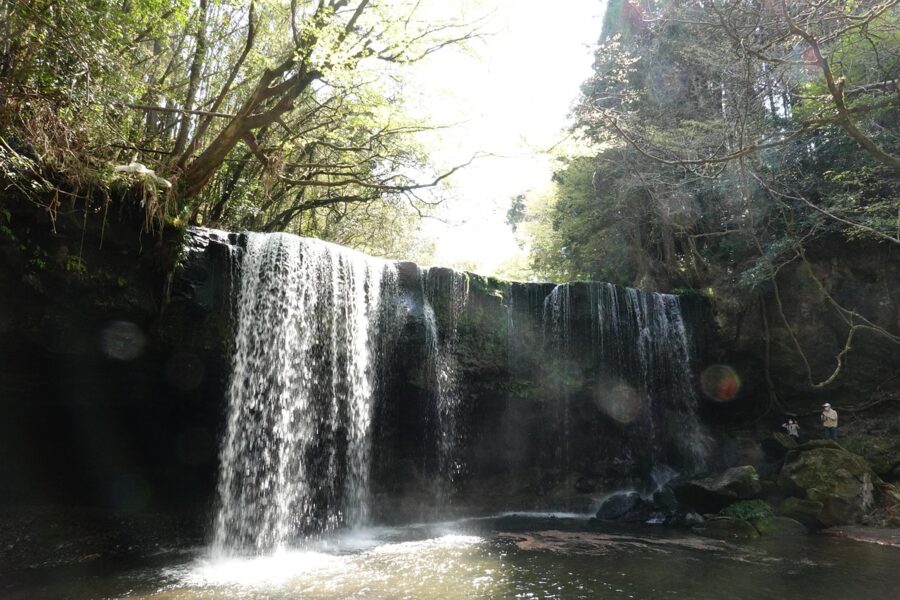
You can’t see Nabegataki (鍋ヶ滝) from the car park. You hear it on the steps going down through the cedar, and then the path turns and the whole width of it is there at once: a curtain of water about 10 meters (33 feet) high and about 20 meters (66 feet) across, falling clear of a dark rock lip into a wide green pool. A minute later you are standing behind it, looking out at the forest through the water.
That walk behind the water is the reason Nabegataki is the best-known sight in Oguni (小国町), the cedar town at the northern edge of the Aso caldera, and the reason it now runs on tickets. It is a small waterfall by any measure, in a small park in the hamlet of Kurobuchi (黒渕). Go knowing the rules, the hour and the weather, and it repays the drive.


Contents8 parts
Ten meters high, twenty across
The town gives the measurements plainly: a drop of about 10 meters and a width of about 20. Nabegataki is what Japanese calls an urami no taki (裏見の滝, a waterfall you can view from behind), and among those it is the one people think of first. The name means roughly “pot falls,” though nobody agrees on why.
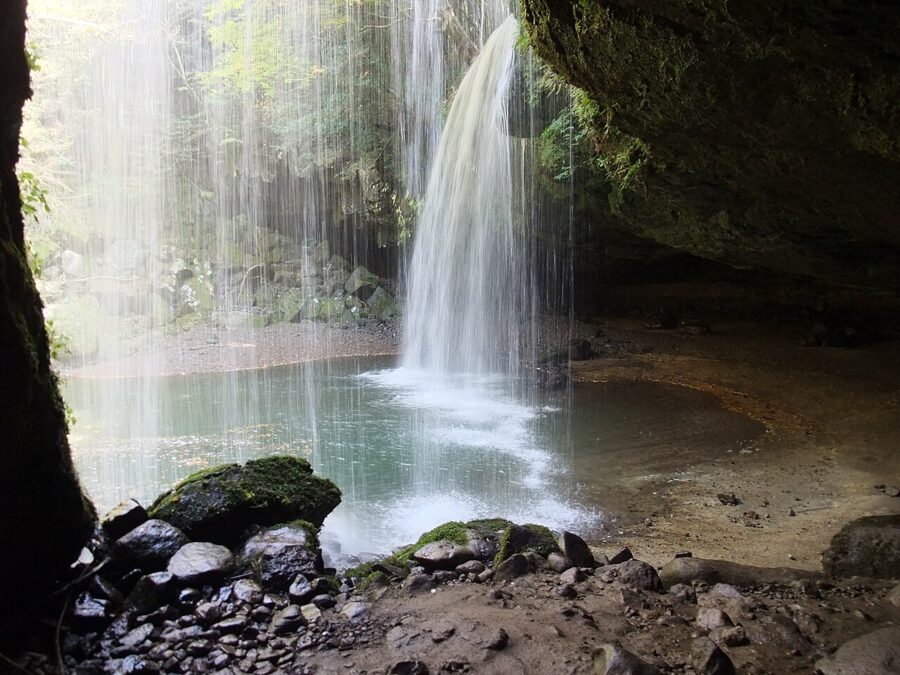
Standing in front, the falls read as one sheet split into strands, breaking into separate threads toward the ends. The pool below spreads wide and calm once the spray settles. Above it, the rock arches over a long hollow, and that hollow is the whole point.

How a volcano made a waterfall you can walk behind
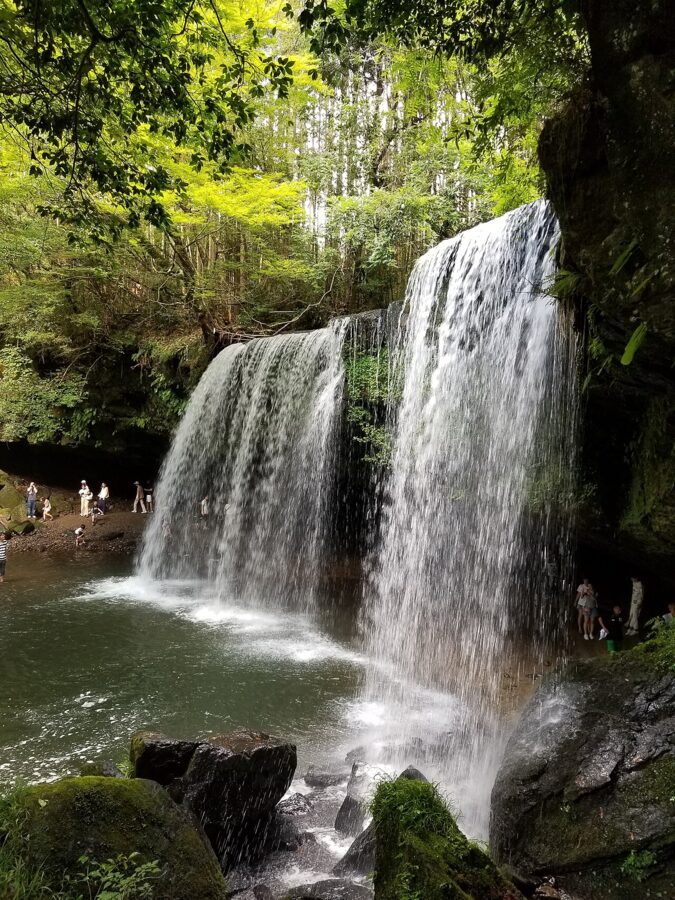
Oguni’s own account is that the falls date from the huge eruption, about 90,000 years ago, that created the Aso caldera. That eruption sent pyroclastic flows of hot ash and pumice across much of central Kyushu, and where they settled thickly they welded into hard rock. Nabegataki’s lip is that hard rock.
Under it lies a softer layer. Spray, splash and seepage have eaten into it far faster than the cap above, so the stream now falls clear from an overhang with an open room beneath. The town notes that the hard bedrock at the top and the soft strata behind are still eroding and still changing shape, slowly. It is one of the sites of the Aso Geopark, which was certified a UNESCO Global Geopark on September 23, 2014.

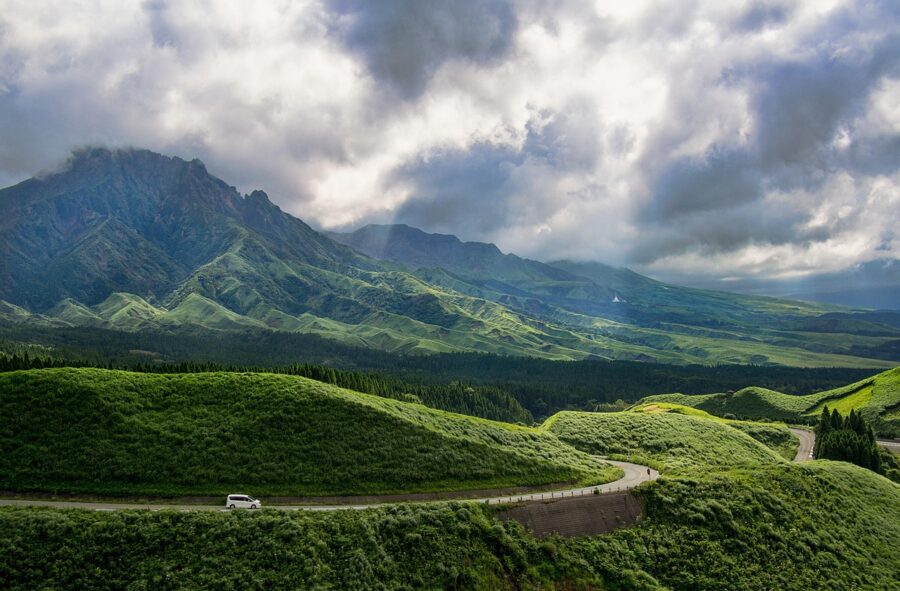
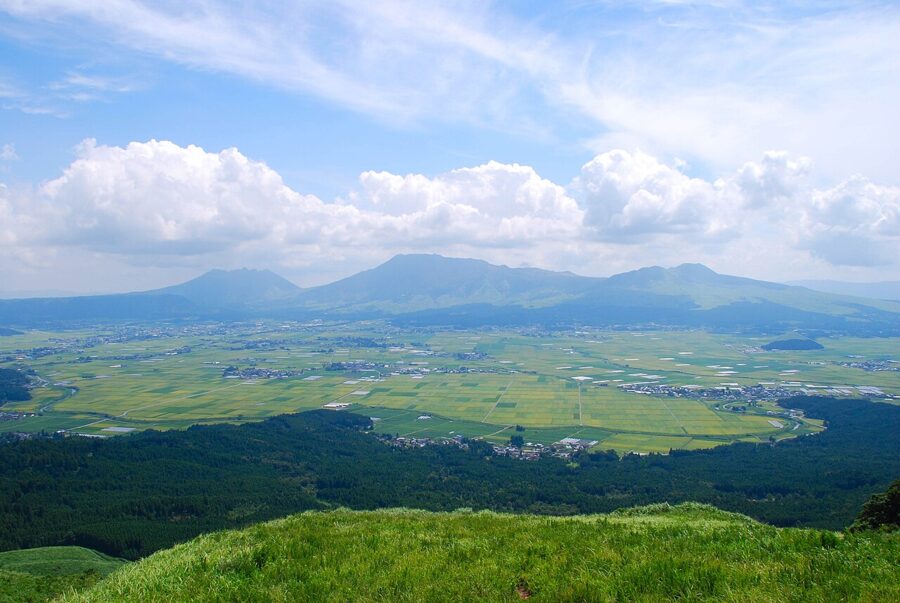
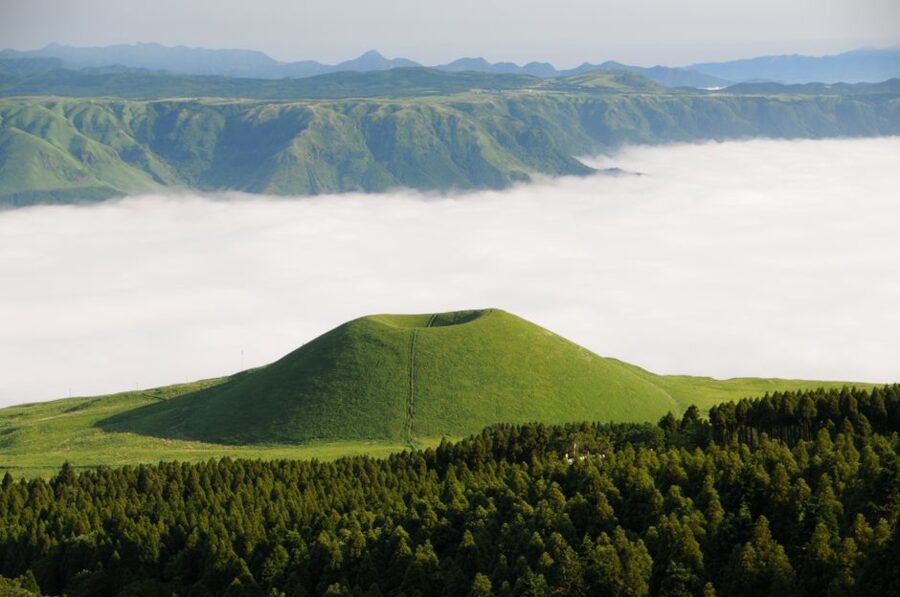
If you want to see the scale of what made the falls, drive up to the caldera’s northern rim and look south. The farmland, cones and grassland inside are the far end of the same story, and on a cool morning they sit in cloud.

From a quiet stream to a ticketed park
For most of its life Nabegataki was a local spot. What changed it was a Kirin Nama-cha green tea commercial in the 2000s, starring the actress Matsushima Nanako and filmed at the falls. After it aired, the falls went from a place only locals knew to a stop on national itineraries, and the figure usually quoted is around 240,000 visitors a year.
The town responded with steps down to the pool, then with parking on the site of a nearby former school and shuttle buses to the falls. The lane through Kurobuchi still jammed on holidays. When the pandemic stopped the shuttles in 2020, Oguni changed the system instead of the road.

Since November 4, 2021, entry has been by advance purchase online. The town’s own question-and-answer sheet gives two reasons: traffic congestion in the surrounding hamlets had become a serious problem, and the town wanted a way to keep receiving visitors even in a situation like the pandemic. The result is fewer cars backed up in the lane, and a few days a year when you cannot get in without a ticket.
Tickets, booking and hours (as of November 2026)
The basics, from the town’s Nabegataki rules, updated September 29, 2026:
| Item | As of November 2026 |
|---|---|
| Adults (high school age and up) | ¥300 (about US$2) |
| Children (elementary and junior high) | ¥150 (about US$1) |
| Under elementary school age | Free, no booking needed |
| Disability certificate holders | Free, no booking needed; show it at the gate; one companion free |
| Hours | 9:00 to 17:00, last entry 16:30 |
| Closed | December 28 to January 3, plus temporary closures |
| Parking | 123 spaces; no large tour buses |
Tickets are sold for a date and entry time through the ticket site Webket, linked from the ASO Oguni Tourism Association’s booking guide. You register for free, pay by Visa, Mastercard, JCB or American Express, and receive an e-ticket with one QR code per person, shown on a phone or printed. There is no booking fee and no discount for buying online.
You can buy on the day itself, as long as the time slot hasn’t started. The association asks that you keep your stay to between 40 minutes and an hour, and once you leave you cannot go back in. Changing a time means cancelling and rebooking, and cancellations close three days before the visit, after which there are no refunds.

Full-reservation days and walk-ups
Booking is not compulsory every day. In 2026 the town only made the park fully reservation-only on set days in May, August and September, around Golden Week, the Obon week and the September holidays, as shown on the 2026 schedule. On those days you need a web ticket or a same-day ticket. On the days left blank, the schedule says you can enter without a reservation.
If you can’t book online, the ASO Oguni Tourism Association issues same-day tickets in person from 8:30 a.m. to 4 p.m. They do not take bookings by phone, and on busy days the slots can be gone. I would book online the night before for any weekend or holiday, and only count on a walk-up on a weekday.
Closures: rain, typhoons and tree work
The park closes without much notice when a heavy rain or flood warning is issued or the river rises, when a typhoon warning is in force, after an earthquake or other emergency, and during system maintenance. The town posts closures on its own site, and warns that the opening information on Google Maps can lag behind. Check the morning you go.
As of November 2026 there is also a run of planned closures for tree felling inside the park: November 13, 14, 17, 24, 25 and 28, 2026. If your trip falls on one of those dates, there is no way in.
The walk down and the walk behind
The park entrance is by the car park and the ticket gate, and the falls are about three minutes’ walk below. It is steps and a steep slope all the way, and there is no wheelchair route. Going down is quick, but the climb back up is the part to plan for if anyone in your group walks slowly.
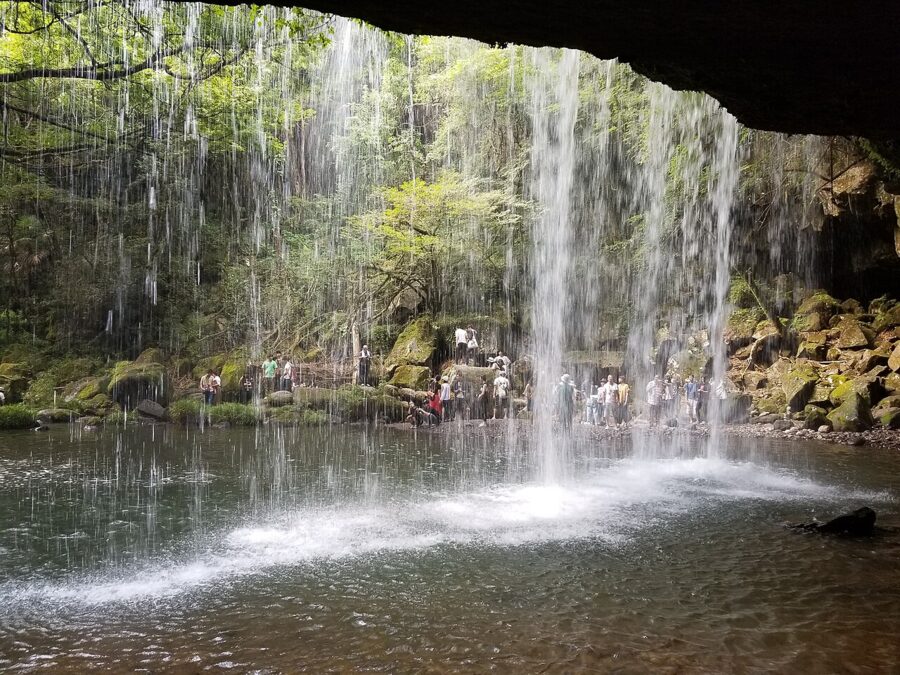

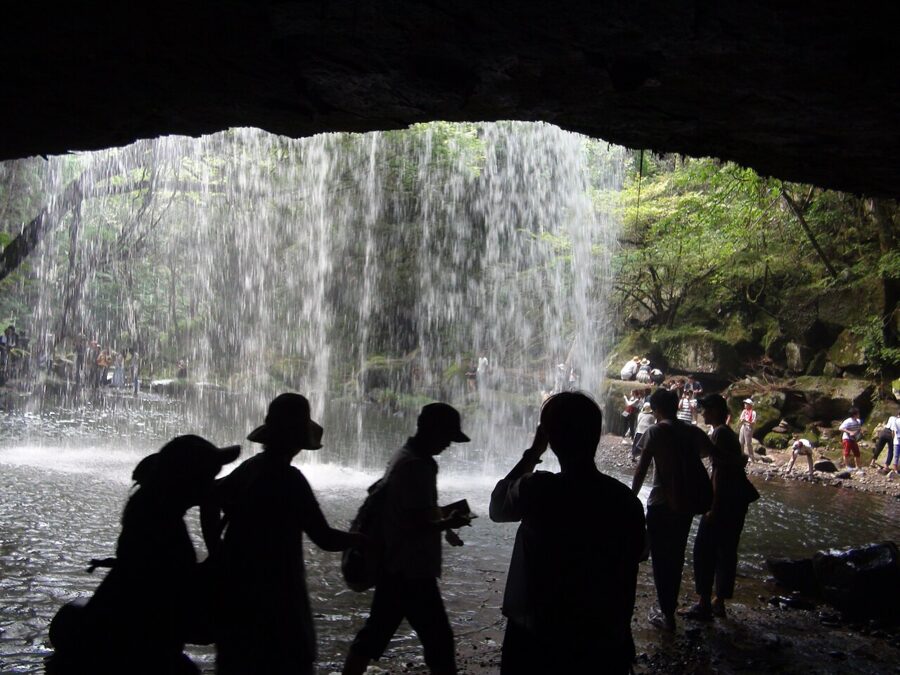
At the bottom the path reaches the pool, and you can cross toward the far side and duck into the hollow behind the water. The ground there is sand and stone, wet from spray, and the town is clear that anywhere behind the falls or on the opposite bank is river area you enter at your own risk, watching for falling rocks and for slips. Wear shoes with grip, not sandals or anything white you care about.
Behind the curtain the air is noticeably cooler, even in August, and spray drifts in on any breeze. A small towel and a plastic bag for your phone are worth more here than a jacket.

Photographs and the best light
The light that makes Nabegataki is sunlight coming down through the trees behind the falls, so that from the hollow the water turns translucent and from the front you can sometimes catch beams through the spray. That happens when the sun is low enough to reach through the canopy, which in practice means the first slots of the day. The first entry at 9 a.m. also gets you the falls before the late-morning rush.
Overcast days are kinder than they sound. Without hard sun the curtain and the moss read evenly, and the green of the forest beyond the water comes through better.

As for equipment, the park’s rules say that filming or photography for anything beyond personal use needs an application to the town in advance, and that long or exclusive use of the park needs permission. I could find no published rule specifically on tripods or drones. With a 40-minute stay and a narrow wet ledge, a tripod gets in everyone’s way, and I would ask at the gate before flying anything.
Light-up evenings
For a few nights a year the falls are lit from behind after dark, and the curtain glows in changing colors. These evenings are announced season by season rather than fixed, so treat any date as something to confirm.
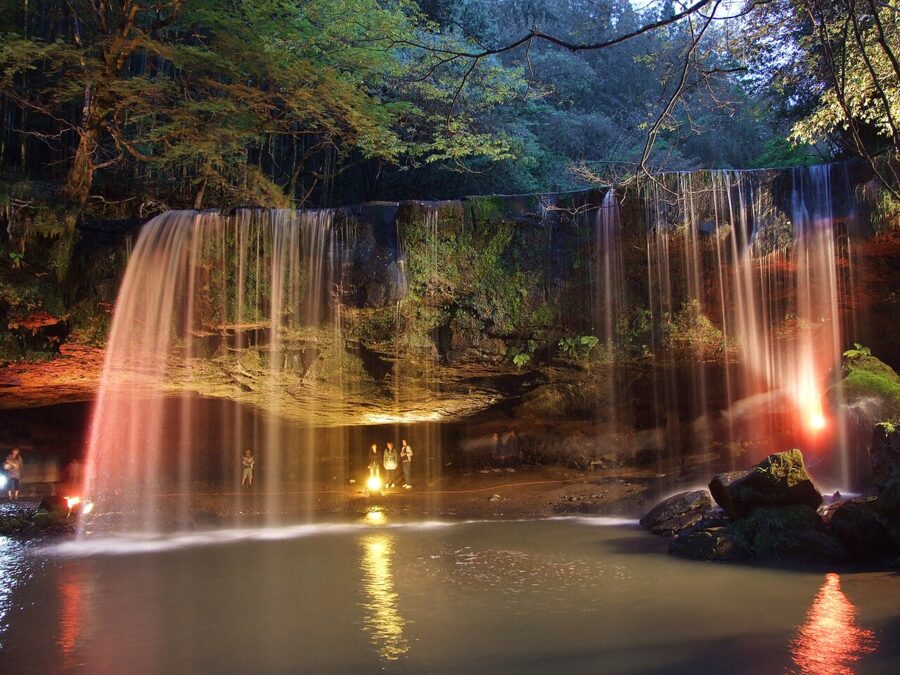

The spring light-up has a long history. In April 2024 the local group Kurobuchi 387 (Mihana) Kai brought back its “Water and Light Fantasy” after a pandemic break, lighting the falls each evening from April 4 to 8, 5 p.m. to 9 p.m. In autumn 2026 there was a different arrangement: a chartered night opening on three evenings, November 14, 20 and 21, with online booking open until 8 p.m. on the day.
The travel company JTB also sold a light-up bus plan from Kurokawa Onsen to its own hotel guests. If you are staying in the area in spring or autumn, ask your inn whether a light-up is on.
Seasons, and when not to go
The falls are at their fullest after rain, which is the paradox of the place: the same downpour that thickens the curtain can close the park while a warning is in force. The best compromise is the first clear morning after wet weather, once the warnings have lifted.
Summer is when Nabegataki earns its reputation. The cedar and moss are at their greenest, the hollow behind the water is cool on the hottest afternoon, and it is also when the crowds come. Autumn brings lower water and colored leaves on the slope above, and pairs well with the Shimonojō ginkgo when it turns yellow.
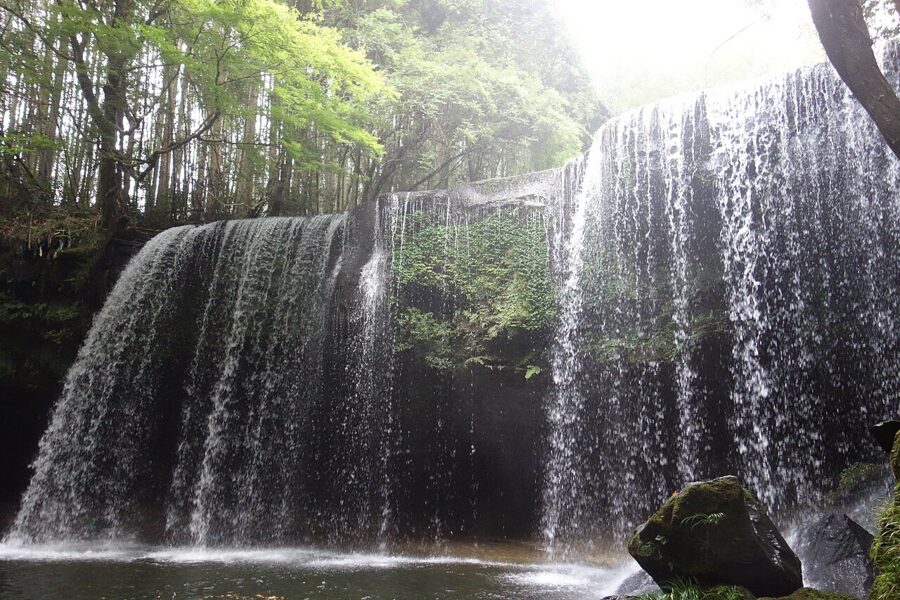

Winter is cold, damp and quiet behind the water, and some guides describe frost and icicles on the rock in a hard cold spell; I couldn’t confirm how often that happens, so don’t plan a trip around it. The park closes from December 28 to January 3.
When to avoid: Golden Week at the start of May, the Obon week in mid-August, the September holiday run and any weekend late morning. Those are exactly the full-reservation days, and the lane in is narrow. A weekday at 9 a.m. is a different place.
Getting there
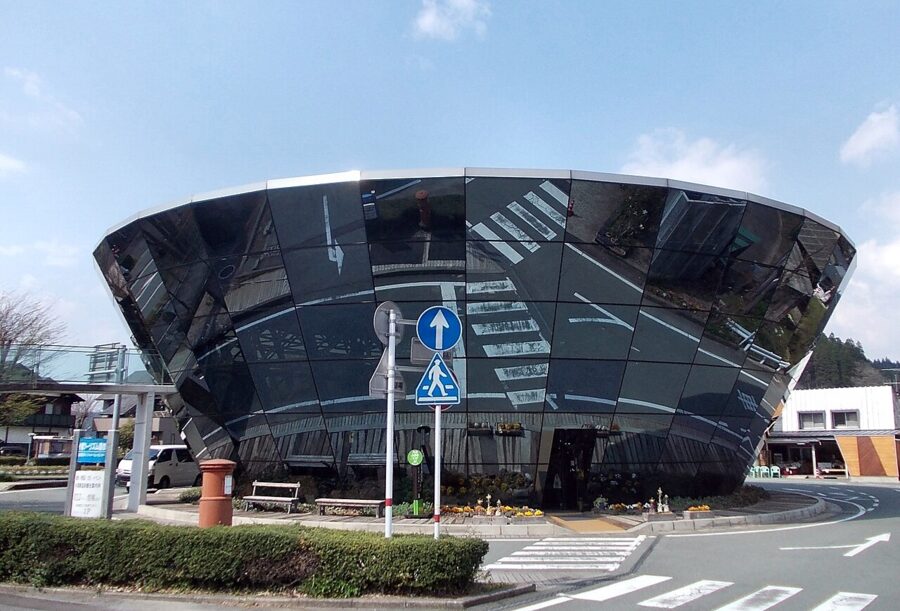
Nabegataki is in the west of Oguni, about 10 minutes by car or taxi from the town center at Michi-no-eki Oguni, the roadside station everyone calls Yu Station. The town gives the drive as about an hour from the Hita interchange on the Oita Expressway and about an hour and a half from the Kumamoto interchange on the Kyushu Expressway.
One practical tip from the booking guide: car navigation systems can send you astray if you enter the address. Set the Sakamoto Zenzō Museum of Art instead, which sits just before the falls, and follow the signs from there for about two minutes.

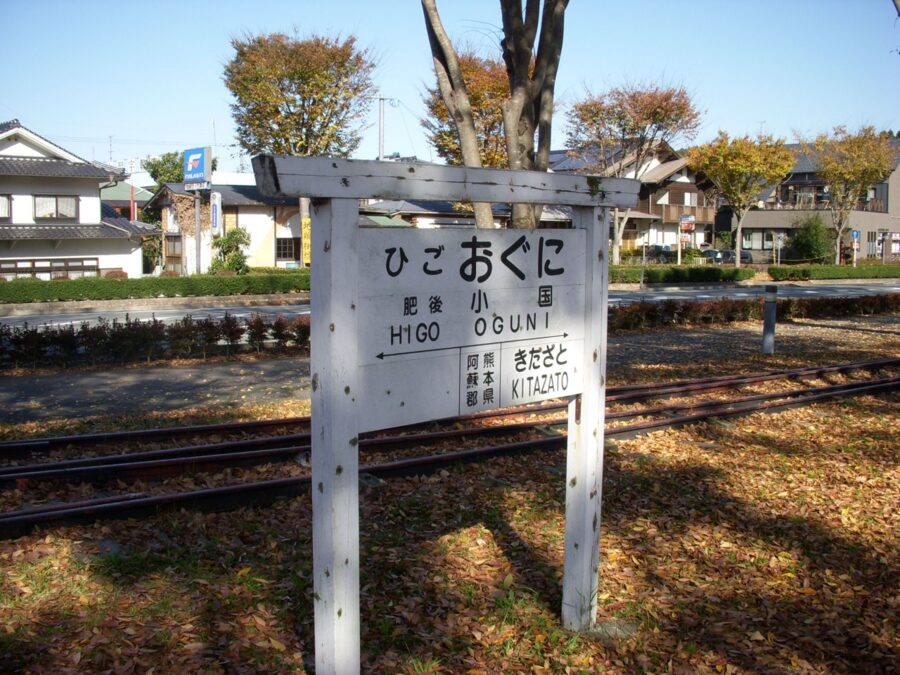
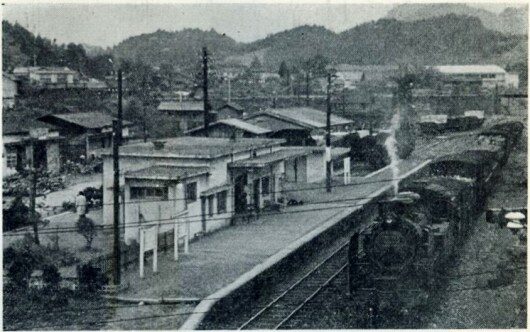
Without a car, aim for Yu Station. The town’s access page lists highway buses from Hakata Station and Fukuoka Airport bound for Kurokawa Onsen, which take about two and a half hours and must be booked, and Sanko local buses up from JR Aso Station over the caldera rim at Daikanbo. From Yu Station it is a 10-minute taxi ride to the falls; with a timed ticket, arrange the taxi ahead rather than hoping for one.

What else is near
Oguni is waterfall country, and Nabegataki is only the most famous of several. The others come without tickets, and most come without crowds.
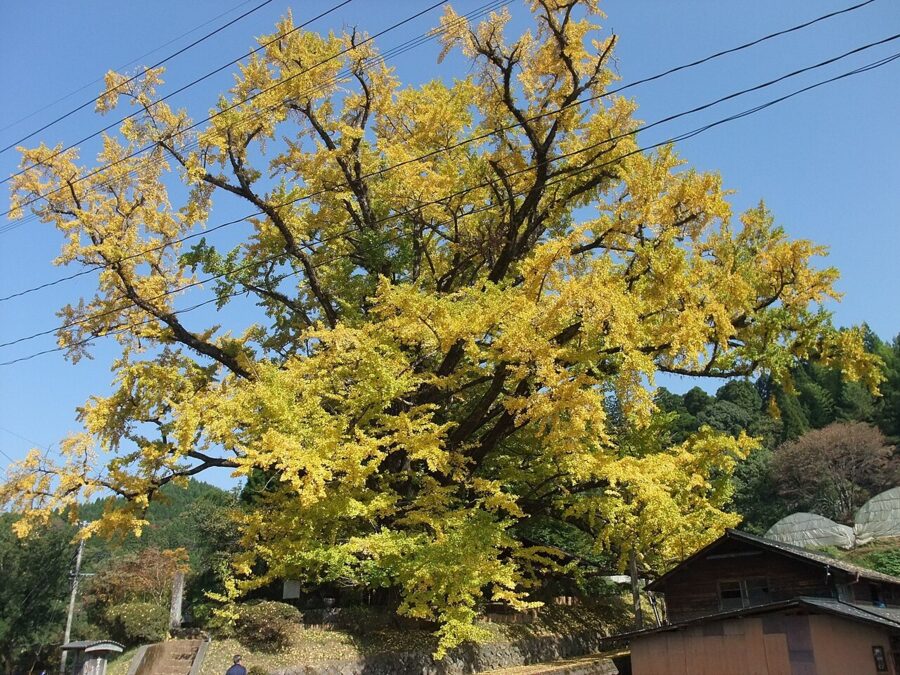
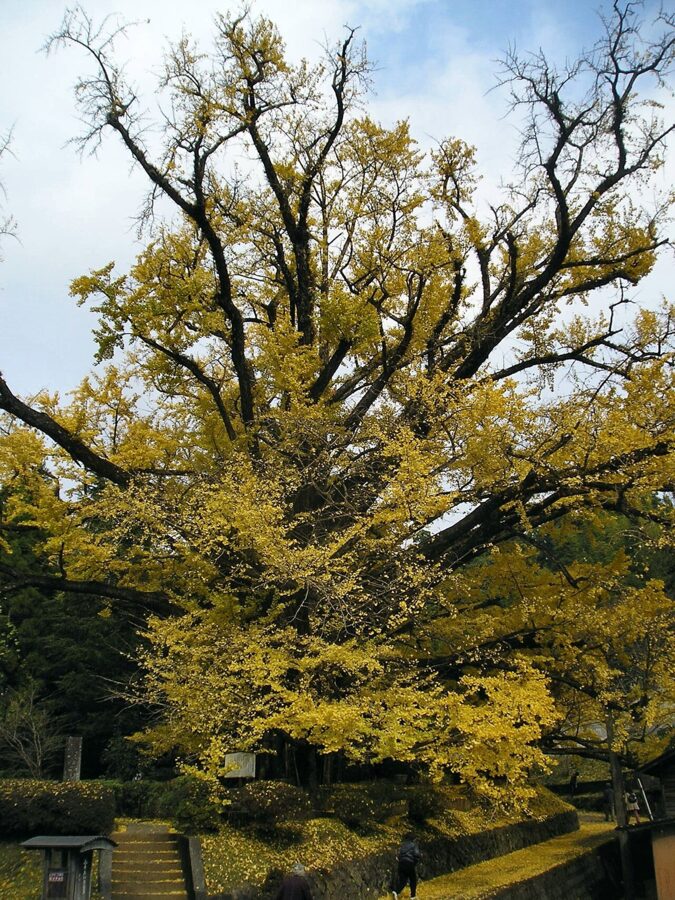
The nearest big pairing is the Shimonojō ginkgo, a few minutes’ drive to the northeast. The town says it is said to be over 1,000 years old, the largest ginkgo in Kumamoto Prefecture and a national natural monument. Locals call it Chichikobu-san, and an old belief holds that a brew of its bark helps nursing mothers whose milk is slow to come. In the yellow season, mid-October into November, it is lit up after dark.


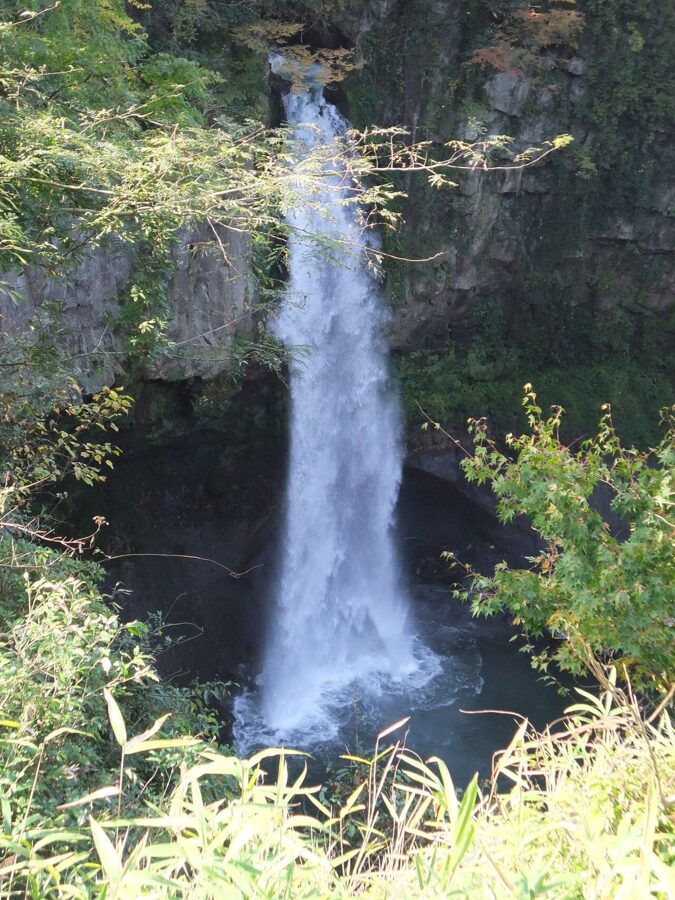
Right beside the ginkgo, Shimonojō Falls drops about 40 meters down a sheer cliff in one go, the opposite of Nabegataki’s low, wide curtain. The town has laid a walking path around it, and a viewing point lets you look down on the falls from above.

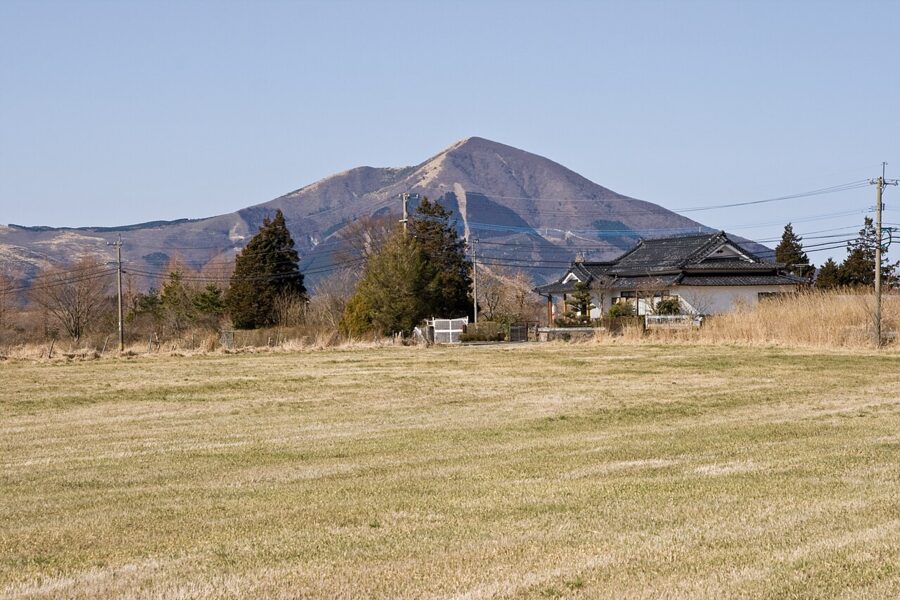
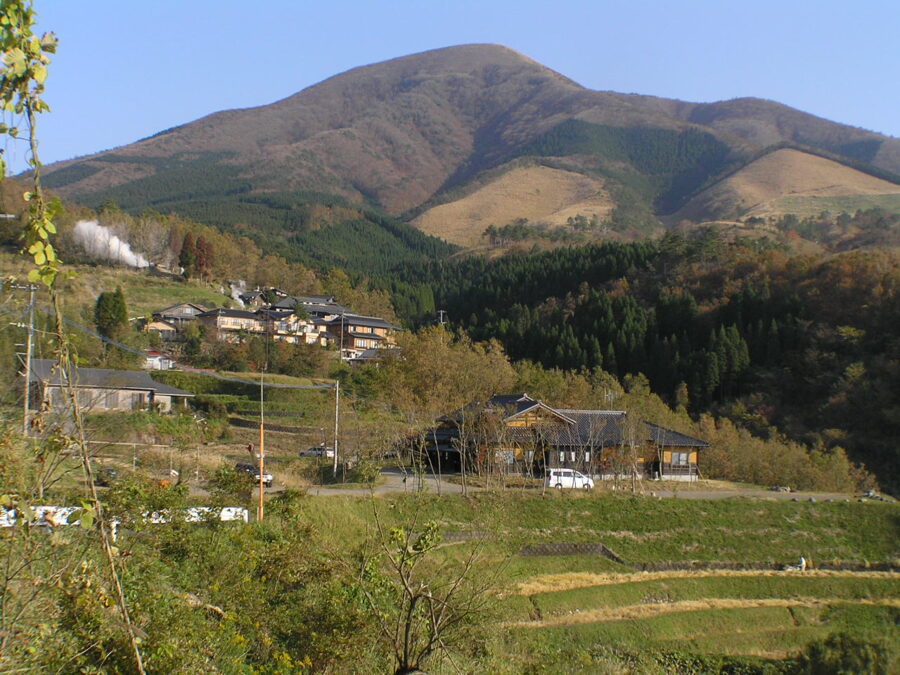
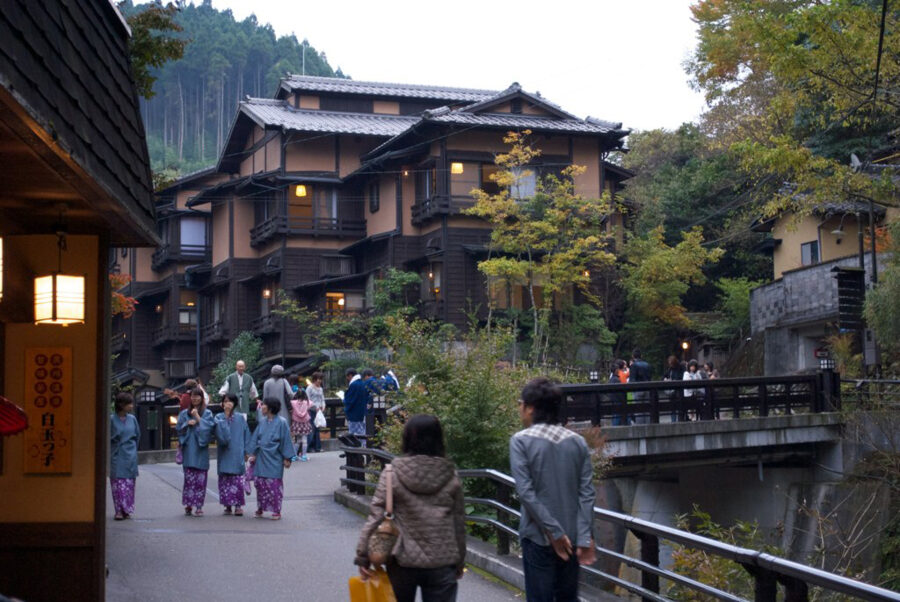
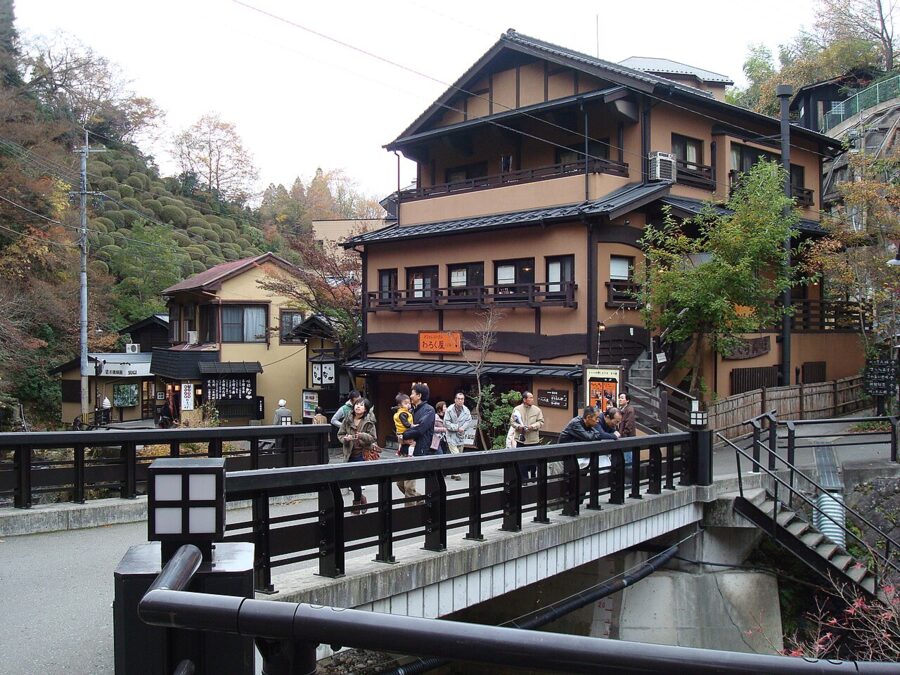
For hot springs, go east to Waita, where steam rises out of the hillsides under Mount Waita. Kurokawa Onsen, over the hill in Minamioguni, is roughly half an hour by car and makes the classic evening after a day at the falls: a riverside village of inns and outdoor baths, best walked in yukata after dark.




If you only have one morning, here is the order I would take: book the 9 a.m. slot, park, walk down without the camera, and spend the first minute behind the water just looking out. Then the ginkgo, then the baths.